
Timothy W. Whitaker is a Retired United Methodist Church bishop who served the Florida Area of the denomination from 2001 until 2012.
UM Voices is a forum for different voices within the United Methodist Church on pressing issues of denominational concern. UM Voices contributors represent only themselves and not IRD/UMAction.
The classic locution of serene secularism is Lucretius’ poem De Reum Natura (On the Nature of Things).
The Roman poet Titus Lucretius Carus (98-55 B.C.E.) believed in the philosophy of Epicurus (341-270 B.C.E.) His poem teaches us that we should banish all fear of gods, death, and life because we shall all die a death that is the absolute end, and therefore the end of fear as well as of joy.
In Rolfe Humphries’ translation, Lucretius wrote:
We may be reassured that in our death
We have no cause for fear, we cannot be
Wretched in nonexistence. Death alone
Has immortality, and takes away
Our mortal life. It does not matter a bit
If we once lived before.
Lucretius died about fifty years before the birth of Jesus of Nazareth in the Roman province of Judea. He could not have imagined the series of events that would take place in Judea in April of 30 C.E.
Within a short time the self-assured Epicurean world of serene secularism would be disturbed by the public announcement of the followers of Jesus that he is the Messiah of Israel, the Lord of the world, and the Son of God who died for our sins, who was buried, and who was raised on the third day–all in accordance with the scriptures of the Jews who worship the one, true living God (Romans 1:3-4; 1 Corinthians 15:3-5; 1 Thessalonians 1:9-10).
The “third day” when Jesus was raised from the dead by the Creator, the God of Israel, was Sunday, the first day of the week (Mark 16:2). Sunday has now become the Lord’s Day, the day to worship the one God and the one Lord in the one Spirit (Revelation 1:10; 1 Corinthians 16:2).
After two thousand years of Sundays, we may still try to return to the serene secularism of Lucretius.
One of the best-known poems of Wallace Stevens is Sunday Morning, which was first published in the early 1920s.
The opening verses describe a woman in her dressing gown enjoying a late breakfast on a Sunday morning:
Complacencies of the peignoir, and late
Coffee and oranges in a sunny chair,
And the green freedom of a cockatoo
Upon a rug mingle to dissipate
The holy hush of ancient sacrifice.
She chooses not to go to church in remembrance of what Stevens describes in last two lines of the first stanza:
Over the seas, to silent Palestine,
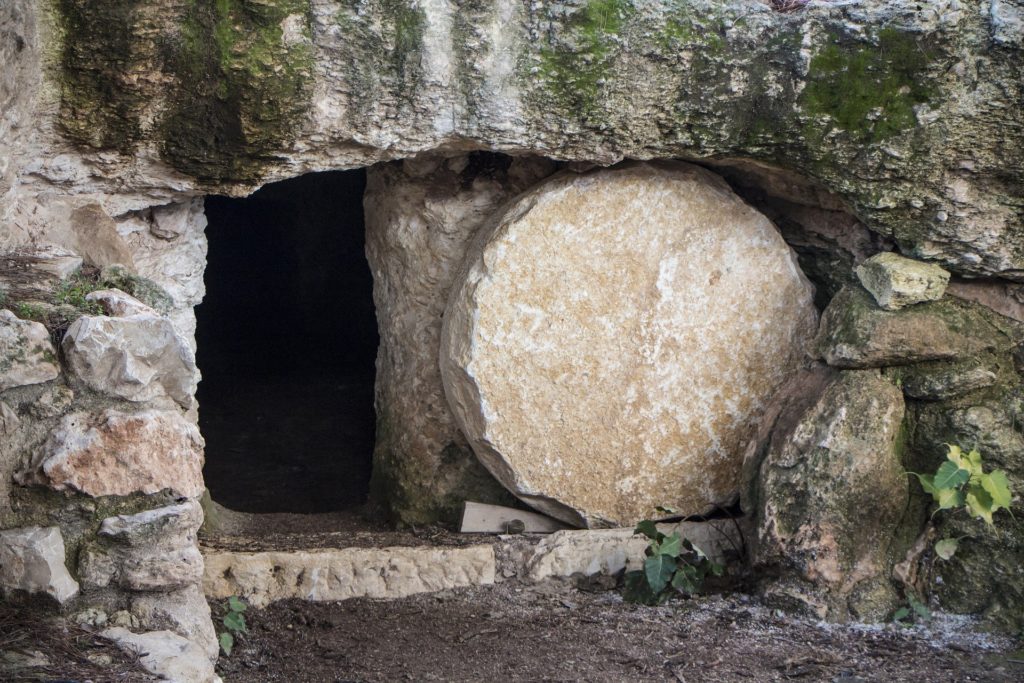
Dominion of the blood and sepulchre.
By her manner, the woman shows that she refuses the offer of eternal life in the message of the death and resurrection of Christ. In the second stanza, Stevens asks:
Shall she not find in comforts of the sun,
In pungent fruit, and bright, green wings, or else
In any balm or beauty of the earth,
Things to be cherished like the thought of heaven?
In the eighth and final stanza, Stevens tells us that if we listen to our doubts then we, like the woman on Sunday morning, may hear
A voice that cries, “The tomb in Palestine
Is not the porch of spirits lingering.
It is the grave of Jesus, where he lay.”
We can try to substitute for Christian faith a serenity based upon absolute doubt. It is harder for us today than it was for Lucretius because not only do we have to believe in the triumph of death over all, but also we have to deny Jesus’ triumph over death. It can be done, of course, and it has been done by many over the last two thousand years. God created us in God’s own image with a certain freedom.
Though we are free to deny it, the gospel of the death, burial and resurrection of Jesus Christ will never go away, and it will be proclaimed in the world every Sunday by someone somewhere. Even Wallace Stevens’ woman was haunted by thoughts of “the holy hush of ancient sacrifice” and “the tomb in Palestine.”
On Easter Sunday, and on each and every Sunday morning, consider these words of the great missionary and theologian Lesslie Newbigin in Foolishness to the Greeks: The Gospel and Western Culture:
From the point of view of our contemporary culture, the claim that God raised Jesus from the dead is irrational. It cannot be incorporated into the existing plausibility structure. The widespread phenomenon of “religion,” with Christianity regarded as one of its many varieties, can indeed be accommodated without difficulty in our culture. But this claim cannot. It must be regarded as the esoteric belief of a community that is living in a world of make-believe rather than the world of facts. There is no way by which the truth of the claim can be demonstrated within the plausibility structure that shapes the modern mind. It is, of course, equally true that the contemporary dominance of this plausibility structure is no proof of its congruence with reality.
At the conclusion of Peri Pascha (On Pascha), a homily and also the Christian Passover liturgy of the Christians of Sardis in the latter half of the second century C.E., according to the translation of Alastair C. Stewart, Melito, the bishop of Sardis, dramatizes the appearance of the risen Lord who speaks:
“Who takes issue with me? Let him stand before me.
I set free the condemned.
I gave life to the dead.
I raise up the entombed.
Who will contradict me?”
“It is I,” says the Christ,
“I am he who destroys death,
and triumphs over the enemy,
and crushes Hades,
and binds the strong man,
and bears humanity off to the heavenly heights.”
“It is I,” says the Christ.
Sunday morning is the ever-new morning of the Lord’s Day, the day that forever belongs to Jesus Christ, the crucified, buried, and risen Lord of the world.



Comment by To Groom on April 18, 2020 at 9:03 am
Thank you, Bishop! It is good to see you writing and sharing again.
Comment by Jerry Dominick on April 18, 2020 at 2:46 pm
You ask me how I know he lives, HE LIVES! within my heart!