Underreported amidst COVID-19 news coverage is the overwhelmingly positive response that the Roman Catholic Church in the United States has shown in the wake of the virus.[1] The Church has responded to crises before; it rose to the occasion during the Great Depression, the racial, social and political turbulence of the sixties, and the AIDS epidemic. But the Coronavirus presents an entirely new challenge: the pandemic has shut down places of worship and in-person gatherings for the foreseeable future.
Dioceses from coast to coast have closed Catholic schools, issued dispensations for weekly Mass attendance, and suspended public masses. Due to these drastic but justified measures the archdioceses found creative ways to still allow their faithful to participate in critical components of the Catholic faith as well as ways to help the archdioceses’ surrounding communities.
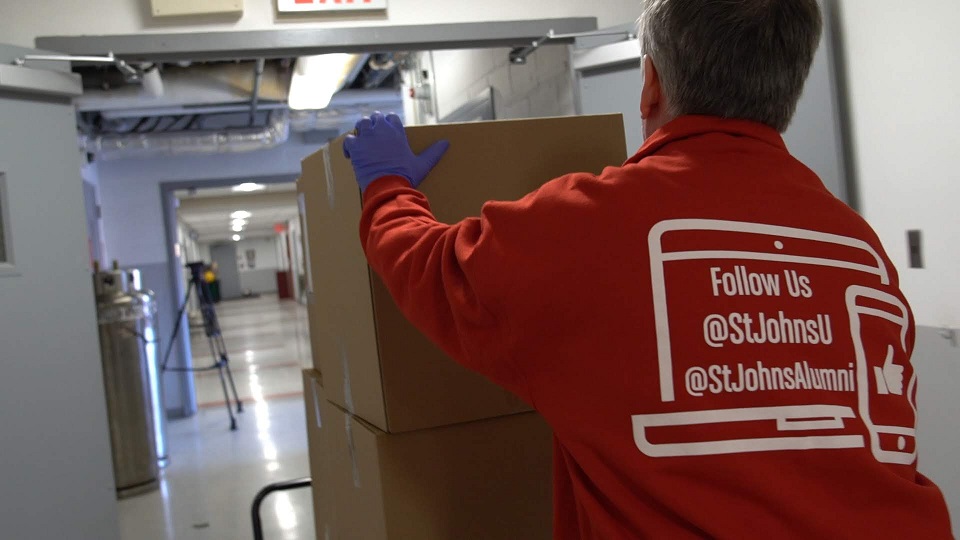
Catholic universities like St. John’s University in New York are donating unused medical supplies like gloves and facemasks to local hospitals that face supply shortages.
“Part of the founding and enduring Catholic and Vincentian mission of St. John is to answer the question: ‘What must be done?” noted Brian Browne, Saint John’s University Office of University Relations Director.
The university answered that question by donating 186,000 pairs of medical gloves, 500 disposable lab coats, 100 surgical masks, and 20 protective face shields to the New York Presbyterian Hospital which faces a shortage of personal protective equipment.
“Solidarity is one of the central tenets of Catholic social teaching, a key thread in social justice,” writes Trinity Washington University President Patricia McGuire in a blog post. The campus is donating space for COVID-19 testing tents.
The Roman Catholic Church is the largest non-government healthcare provider in the United States. There have been countless examples in recent weeks of Catholic hospitals stepping up with resources and facilities to help their communities accommodate a surge in patients. An inspiring story comes out of Buffalo, New York where Catholic Health, a non-profit healthcare system in Western New York, is purchasing a new test from the company Cepheid, a California based pharmaceutical country. This new test “is able to detect the virus faster than previous methods” and “could process 800 tests per day,” according to Mark Sullivan, president of the Catholic Health system.
Sullivan and the Catholic Health Company are assisting local for-profit hospitals deal with the burden of the recent surge in patients because, according to Sullivan, “the Erie County Public Health Laboratory can do 100 tests per day and the results take a couple of days.”
The new test that Catholic Health plans to offer will only work with Catholic Health associated hospital machines but it will be able to process test results in forty-five minutes.
Just because Church buildings are closed doesn’t mean that services aren’t being offered by churches for their parishioners. Online live-streamed Masses, rosary sessions, and Bible studies have already been widely reported on, as have widespread accounts of “drive-in” Masses and “drive-through” Confession.
The central leadership body of the Church in America, the U.S. Conference of Catholic Bishops, has a list of resources for Catholics who have questions regarding certain aspects of their faith participation during a time when most churches are shuttered.
“We have been trying to serve as a helpful resource to the bishops [in dioceses across the country] so they may continue their ministry,” USCCB Director of the Office of Public Affairs, Chieko Noguchi wrote to me about the organization’s response to COVID-19.
The initial USCCB response to COVID-19 began when Conference President Jose H. Gomez issued a reflection and prayer on March 13. USCCB created social media content and prayer cards. Perhaps the biggest help that USCCB has been to dioceses is that the communication team with USCCB sent diocesan communications directors a Facebook toolkit on how to keep their specific communities engaged during a time of social distancing.
“I suggest we pray for local patients and our healthcare workers here at RMMC [Rutland Regional Medical Center], nursing homes and clinics,” local Vermont clergyman Fr. Bernard Bourgeois wrote to parishioners. The Diocese of Burlington put out a statement that outlined resources that Catholics can use from the safety of their home including links to their daily Monday through Friday Masses at 12:05 p.m. ET as well as their Sunday Masses at 10 a.m. ET and a schedule for spiritual resources during COVID-19 restrictions.
The Church’s response amidst the pandemic has shown its community of believers and faithful adherents that the Catholic faith is not just about a building. It is about the faith of the people in congregations across America showing just how committed they are in practicing /spreading their faith outside the church walls in new and creative ways.
Yes, physical Mass attendance, participation in Confession and Holy Communion, in-person prayer sessions and Bible studies are some of the most critical aspects of being a devout Catholic. But the Catholic faith, with its emphasis on both faith and reason, has shown that in times when faith requirements are not possible, it can adapt to satisfy the requirements in a way that obeys the commands of civic leaders and in a way, that protects its’ community of believers.
Throughout this ordeal, one thing remains true after the virus has died down – and indeed until the end of time – that people should “Fear not, for I am with you; Be not dismayed, for I am your God. I will strengthen you, Yes, I will help you, I will uphold you with My righteous right hand” (Isaiah 41:10 NASB).
[1] U.S. Catholic church refers to the combination of formal leadership bodies like the USCCB and informal actors like individual believers and religious schools and organizations (hospitals, relief services, etc.)
No comments yet



Leave a Reply