Saturday I attended an excellent conference on President James Monroe, organized by the Mosby Heritage Area Association, and hosted by Church of Our Savior Oatlands in their beautiful new sanctuary outside Leesburg, Virginia. It’s an Anglican congregation that like many others lost its nearby historic building to the Episcopal Diocese of Virginia because of fidelity to orthodoxy. The new stucco church on beautiful property with huge windows that flood the interior with sunlight and pastoral views fits seamlessly into the Virginia Piedmont.
Monroe himself was a creature of the Piedmont, initially building a home near his friend Thomas Jefferson, and later as president building a home closer to Washington and down the road from what is now Church of Our Savior. After the conference, I happily joined others at a reception at that Monroe home, called Oak Hill. It’s a fantastic place, apparently designed with Jefferson’s help, and where Monroe’s spirit is still very much felt. Some of his furniture is still there. There are two ornate marble mantels gifted to Monroe by the Marquis de Lafayette during his 1824 visit to Oak Hill.
Lafayette was grateful for the Monroes’ help to the Lafayettes during the murderous French Revolution. In 1794 Lafayette was imprisoned in exile and his wife Marie-Adrienne Lafayette was imprisoned in Paris, under threat of execution, her grandmother, mother and sister, as hated aristocrats, having already been beheaded. The Lafayettes had favored a moderate revolution of lawful democracy as the Marquis while a young general had helped to achieve in America alongside his friend George Washington. Awash in blood at this point, the French revolutionary regime and its supportive mobs had no interest in liberty under law.
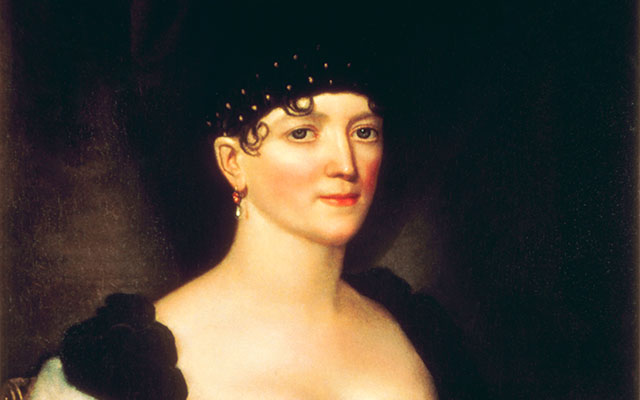
In collaboration with her husband, now the U.S. minister to France who had served with the Marquis in the American Revolution, Elizabeth Monroe contrived to save the life of the Marquess. The Monroes purchased a carriage and had it painted brightly to catch attention, in which an elegantly dressed Elizabeth rode alone to the prison where Marie-Adrienne was incarcerated. As intended, the display caught the interest of Paris crowds, who followed the carriage to its grim destination.
Marie-Adrienne upon hearing the uproar was said to have believed her own execution was now impending. She proceeded to the prison gate where instead she saw Elizabeth, who theatrically embraced the prisoner in front of the vast audience, which cheered the female solidarity. “The sensibility of all the beholders was deeply excited,” Monroe himself recalled. Marie-Adrienne was soon released and, with a passport from Monroe, left France to join her husband voluntarily in an Austrian prison. Her health never recovered and she did not live many more years, but an aged Lafayette never forgot. Elizabeth with her husband hosted Lafayette at Oak Hill 30 years later and doubtless she enjoyed the marble mantels for her six remaining years of life.
The Monroes apparently burned their personal correspondence and little is known specifically of their religious faith. They were both lifelong Anglicans/Episcopalians (she grew up in Trinity Church on Wall Street in New York) whose education, baptisms, family weddings and funerals were conducted by that church, which doubtless influenced their outlooks in innumerable ways, including her stoic courage in Paris. It’s not hard picturing the Monroes sitting in a simple, elegant place of worship like Church of Our Savior, which displays the flag of Virginia behind the altar.
“He had found [the nation] built of brick,” John Quincy Adams eulogized of his colleague and presidential predecessor Monroe, “and left her constructed of marble.” Elizabeth was her husband’s devoted partner across nearly a half century of public service as soldier, legislator, diplomat and president.
Before I left Oak Hill our hostess the owner generously showed me their portrait of Monroe in their bedroom, where sat the Monroes’ imposing four poster bed, which across two centuries apparently never left the house. It signifies the permanence of the Monroes and their accomplishments, which includes Elizabeth’s courageous rescue of Marie-Adrienne de Lafayette. Perhaps Mrs. Monroe should be recalled as an Anglican patron saint of political prisoners. Her exertion should be a spiritual and political example for all.
No comments yet




Leave a Reply