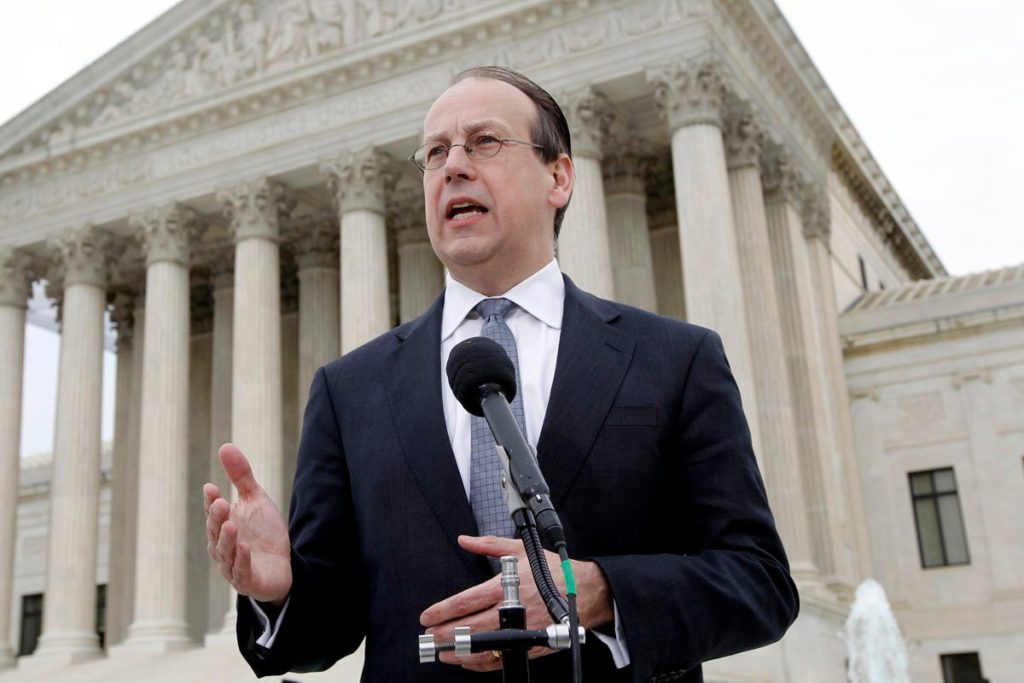
The annual meeting of the Christian Legal Society on Oct. 19-21 included a religious liberty panel discussion focusing on challenges facing Christians in contemporary society. The panel was proceeded with an introduction by Paul Clement, former Solicitor General of the United States, who argued numerous religious liberty cases before the Supreme Court, including the Hobby Lobby and Little Sisters of the Poor cases, the United States vs. Windsor case concerning marriage, and who has defended the religious expression of soldiers.
Clement said that we live in an “acute time” for religious liberty. February 13, 2016, the date of the death of Associate Justice Antonin Scalia, is the most important date for our era. The court lost an “amazing” man in his prime, leaving it in shock for the remainder of the term. Scalia was a “game changer,” Clement said, in terms of getting back to the text of the Constitution. Scalia argued that what should be binding in constitutional law is “the original public meaning of the Constitution.” Before his arrival on the court, decisions were often made based on legislative histories, which indicate legislative intent in passing a law. Most importantly, recognition of original intent as the controlling factor in reaching constitutional decisions rules out an overriding appeal to “constitutional ideals,” used by liberals to elevate their convictions and sensibilities to the status of supreme criterion in American law.
But Clement noted that Scalia’s ruling, written for the majority, in the Employment Division vs. Smith case, which found that there is no constitutional religious liberty protection from “neutral, generally applicable law” is his “least favorite decision” with conservatives. It prompted both Congress and state legislatures to act to protect religious liberty with the same “compelling state interest, exercised by the least restrictive means” standard that existed in constitutional law before the Smith decision. This means, however, that this standard has only statutory, not constitutional, protection at the federal level, and none at all at the state level unless so protected by the state legislature concerned. It can therefore be altered by legislative action, or by judicial action if the Constitution is invoked.
Clement maintains that there are two types of religious liberty cases currently considered by courts. One consists of cases where there is broad public consensus, which achieve 9-0 results on the Supreme Court. These decisions pertain to the internal functions of houses of worship. The Equal Employment Opportunity Commission vs. Hosanna Tabor Lutheran Church decision in 2012, which found a constitutional right to select clergy exclusively on religious considerations, without considering antidiscrimination law and policy, is a good example of this. Scalia’s death, and reasonably future changes on the court, will have little effect on these types of cases.
The second type consists of cases where society is divided between liberal and conservative opinion, which until Justice Scalia’s death resulted in 5-4 decisions on the Supreme Court in favor of a broader religious liberty. The exercise of faith in the public square and religious exemptions from liberal law and public policy are good examples of these latter cases, with the Hobby Lobby decision being the archetypical example. Here there can be expected to be a great loss of religious liberty, with cases very difficult to argue due to a likely final negative end result in a liberal Supreme Court. In general, religious liberty claims prevail if they “do not back into another right,” Clement said. It ought to be added, however, to Clement’s observation, that the “other rights” affected by religious liberty are what has come to be called “positive rights,” or the right to be assisted. “Negative rights,” the right to be left alone, are surely more basic, and that is what religious liberty is in these cases. It should be clear, although unhappily it is not to many in our society, that it is a person suffering the loss of negative religious liberty, and therefore required to take action believed to be sinful or evil, who is imposed on, not the person demanding action.
Commitment to religious liberty is not as strong as it was in previous generations, and Clement believes that this has been the case for “quite some time.” The remarkable consensus of liberals and conservatives that passed the Religious Freedom Restoration Act of 1993, reinstating at a statutory level the “least restrictive means” test, is now gone; religious liberty is no longer generally seen as a “great American value.”
Clement claimed that the “second guessing” of the sincerity of religious claims is more common with familiar religious doctrines widely held in society. This means that the claims of orthodox Christians of all major traditions, now so crucially important as they collide with liberal law and public policy, will receive less favorable consideration than others. The exotic claims of little known or understood minorities are more likely to be successful. Although the prospect of ultimate success with religious liberty cases is now less with Justice Scalia no longer on the court, religious liberty is an “important legal principle … enshrined in the Constitution,” which is “too fundamental” to abandon.
Clement presented a sobering picture of American religious freedom at the present time, which nevertheless must be engaged. It might be added to his comments that the historic commitment of American society to religious liberty and freedom of conscience should not be given up, regardless of negative results in the courts, since duty to a reality higher than ourselves should obviously be our first duty. Christians understand this reality to be the God of the Bible, rather than changing political or legal trends.
The panel’s discussion of specific cases and ongoing religious liberty issues followed, and will be reviewed in a subsequent article.
No comments yet


Leave a Reply