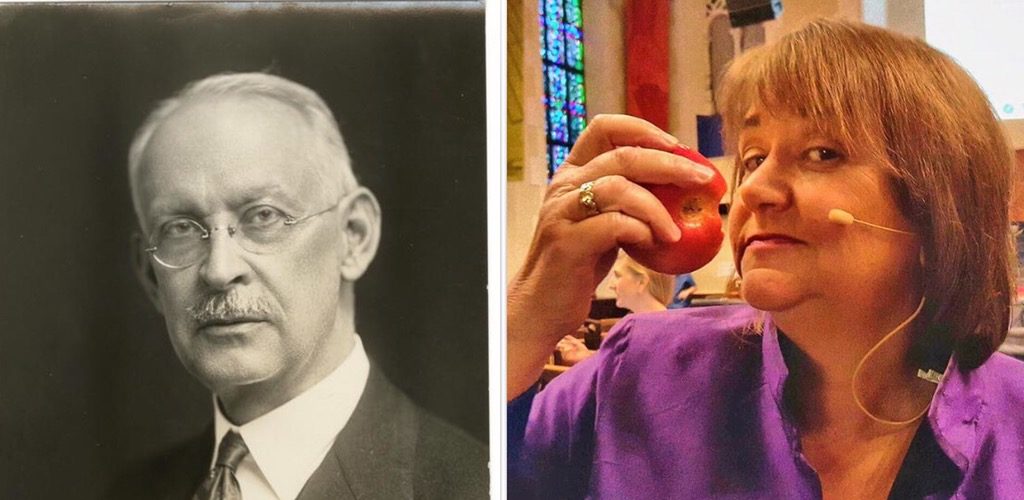
The United Methodist Church’s Western Jurisdiction has defied church law regarding sexual ethics by electing as bishop an openly avowed lesbian married to another woman. Karen Oliveto of Glide Church in San Francisco is a long-time LGBTQ activist and exponent of radical theology and politics. The church’s South Central Jurisdiction has asked the church’s top court, the Judicial Council, to address the legality of her election.
Although it includes the West Coast, Rocky Mountain states and Desert Southwest, the very liberal and fast declining Western Jurisdiction includes only about 2 percent of United Methodism’s global over 12 million membership. It long ago was said that Georgia has more United Methodists than the Western Jurisdiction. Now it can be said that the North Georgia Conference by itself has more members than a region including 10 mostly fast growing states in continental USA, plus Hawaii and Alaska. Very likely in the next decade the Western Jurisdiction, as it further declines with greater speed, will be disassembled, with pieces attached to other jurisdictions, maybe with the creation of a new missionary region that can rebuild what was lost.
In United Methodism jurisdictions elect their own bishops without wider ecclesial. approval. In contrast, under the Episcopal Church system, when the Diocese of New Hampshire nominated Gene Robinson as the their denomination’s first ever openly homosexual bishop, approval was required and gained from the Episcopal Church’s General Convention, setting in motion an ongoing Anglican schism in North America and globally over the last 13 years. The Episcopal Church’s membership decline accelerated, and New Hampshire lost about 20 percent of members under Bishop Robinson, who’s since retired and is now a fellow with the politically liberal Center for American Progress in Washington, D.C.
Unlike the Episcopal Church and other declining USA Mainline Protestant bodies, liberals in United Methodism have failed to liberalize the denomination’s official teaching on marriage, thanks mostly to their own membership losses while conservative overseas United Methodist churches grow. So United Methodist liberals have in recent years touted defiance of church law, which officially teaches monogamy in male-female marriage and celibacy in singleness. Oliveto’s election is the latest defiance.
For many liberal United Methodists, LGBTQ affirmation is the primary justice cause of the day demanding church affirmation. Political social justice advocacy has been a theme of liberal Methodism and much of Mainline Protestantism since early in the 20th century, with a presumed univeralism/syncretism that doesn’t prioritize evangelism or discipleship. Instead, the church’s primary calling is to urge and model egalitarian political social justice. Over the last century there have been many urgent political crusades touted by zealous church activists who claimed their cause of the moment was crucial to God’s Kingdom on earth.
The first such social justice cause for 20th century Methodism was Prohibitionism, which imagined that the legal elimination of alcohol from society would establish public righteousness in which sober Americans were safer, healthier, kinder, more virtuous, more generous and a light unto the rest of the suffering world. It was Methodism’s greatest political success, for a time, and then its greatest failure, after Prohibition’s collapse, from which Methodist social witness and cultural influence never fully recovered.
Bishop James Cannon was a leading light of the Prohibition movement. He helped lead the Anti-Saloon League and led southern Methodism’s temperance cause. Sardonic journalist H. L. Mencken said of Cannon, of whom he was a critic but also an eventual friend who admired his political prowess, that “Congress was his troop of Boy Scouts and Presidents trembled whenever his name was mentioned.” Voluntary temperance, rooted in Wesleyan and Christian teaching, was noble. Coerced, stated imposed temperance as a Gospel imperative was more questionable. Prohibition did decrease alcohol usage and arguably accomplished some good, while also feeding corruption and disrespect for the law, making it unsustainable.
Although theologically orthodox, Cannon was not very interested in evangelism or Christian discipleship. His mission for decades was a political cause, on which he focused with myopic and frenzied ardor. Much of Methodism followed him, tacitly agreeing that God’s Kingdom could be enacted through constitutional amendment and more funding for Treasury Department agents to enforce it. Some Methodist conservatives disapproved Cannon and aspects of the Prohibition Movement, believing it a utopian human cause that misunderstood fallen human nature and overestimated the ability to perfect human society, while distracting the church from Gospel proclamation and personal holiness.
Cannon succcessfully campaigned for traditionally Democratic southern states to vote Republican in 1928 against the pro-booze Democrat Al Smith. But Prohibition and Cannon’s career imploded with the Great Depresssion. Methodism eventually moved on to other social justice causes, always involving the expansion of state power in pursuit of societal perfection, but was never again as successful or as influential. Never again was there a Methodist bishop who could make presidents and congressmen “tremble,” fortunately.
The LGBTQ cause within the church is similar to Prohibitionism in its utopian desire to reinvent human reality and coercively impose upon society an artificial and ultimately unsustainable social construct at odds with human nature and creation. It also like Prohibition and other radical Social Gospel movements is rooted deeply in American culture and speaks in the language not of the universal, historic church but of American political categories, centered on personal autonomy. Methodism with Mainline Protestantism has suffered from a largely one-nation ecclesiology captive to the here and now while excluding the corrective voice of saints outside the present culture.
Over the last 30 years United Methodism, unlike the rest of liberal USA Mainline Protestantism, has become a global church. Within a decade or less most church members will be outside the USA, mostly Africa, where 41 percent of the church now resides. A majority of the 9 member Judicial Council that will adjudicate Bishop Oliveto’s legal status are from outside the USA.
A global church has its own inevitable tensions but it also is more protected from the preoccupations of particular cultures, USA or otherwise. No church should subordinate its core Gospel message to the political fads of its own time and place, which may seem compelling at the time, but considerably less so upon later consideration. Protestants have been especially prone to national churches. But with the rise of Western secularism and surging global Christianity, most such denominations will not survive without enhanced collaboration with and appreciation of the universal church, on earth, and across history. Such church universality will both protect the church’s message and enlarge its appeal.


Comment by Dan on July 18, 2016 at 6:00 pm
Great analysis Mark, but isn’t the Western Jurisdiction alone responsible for deciding who can be a bishop there, with no right of recission by the Judicial Council because it is not within their purview?
Comment by the_enemy_hates_clarity on July 19, 2016 at 9:29 am
It will be ironic (and humorous) to watch the Western Jurisdiction twist itself into a pretzel to argue that the Judicial Council must follow the Discipline in order to allow the Western Jurisdiction to not follow the Discipline.
By the way, this is a great article.
In Christ,
The enemy hates clarity
Comment by Nutstuyu on July 19, 2016 at 3:32 pm
Complaints against a bishop would be directed to the president of the College of Bishops in that jurisdictional or central conference. If a resolution is not reached, it can be referred to a Judicial Complaint.
Comment by Creed Pogue on July 19, 2016 at 4:13 pm
Can anyone cite an actual prohibition against the Judicial Council calling an emergency session to take up the request for declaratory decision from the South Central Jurisdiction and use that to vacate Dr. Oliveto’s election?
Comment by Namyriah on July 18, 2016 at 9:11 pm
This will be wonderful, look at how the Episcopal Church grew after they appointed a gay bishop.
Oh, wait,…
Comment by Michelle Wood on July 19, 2016 at 11:12 pm
I know God wants us to all love, and not judge. We are to help and teach eachother rights and wrongs. But you should love the sinner not the sin. Teach the sinner, not be the sinner. Don’t judge because you will be judge on your day. Only do God’s work. And as a preacher you can not be the sinner and not follow His laws. Levitious 20:13 ” If there is a man who lies with a male as those who lie with a woman, both of them have committed a detestable act they shall surely be put to death. Their blood guiltless is upon them.” Our teacher are not true teachers if they are not following God’s laws and the bible. It makes them a false prophet when they go against the bible and become worldly. 1 John 4:1 Beloved, do not believe every spirit, but test the spirits to see whether they are from God, for many false prophets have gone out into the world. Ephesians 5:11 Take no part in the unfruitful world of darkness, but instead expose them. We are to love the sinner, not the sin. Teach the sinner not be the sinner. Not judge, we will be judge on our day. But our teachers can not be the sinners teaching us. It’s false teachings at that point and from the devil.
Comment by Rev, Vaughan Hayden on July 20, 2016 at 1:28 am
Why must they defile The United Methodist Church which has had the same standing since its inception, that homosexuality is against Christian teaching. Everyone one of the clergy was ordained with that same statement in their discipline (unless they were ordained before 1972). If they don’t agree with it, then they should be people of integrity and start their own church that suits their interpretation of Scripture. Leave The United Methodist Church alone.
Comment by John S. on August 1, 2016 at 7:49 am
If you see someone in grievous error, headed down a path of destruction would you not try to help them? (sometimes called evangelism) The same applies to the UMC. Unless one believes that the UMC is God’s ordained presence on earth, incapable of error, then it is incumbent on its members to correct it when it errs. How many times has methodism changed its stances? Female ordination, racism, etc. The is nothing inherently wrong in questioning and possibly changing the UMC.
The UMC love it or leave it! is a terrible doctrine.
Comment by Rev, Vaughan Hayden on August 1, 2016 at 2:13 pm
“There is nothing inherently wrong in questioning and possibly changing the UMC” I completely agree. But after 44 years of questioning and trying to change, it appears that the collective wisdom of the UMC is being undermined. If questioning and trying to change was the issue, we would be in the same place. However, when some decide to shirk the rules and laws that have been settled for years because of personal disagreement or a visceral dislike, that does not give them the right to undermine or simply disregard the laws. It is like someone saying I think stealing should be okay in certain situations so I am going to steal right in front of you and dare you to do something about it and expect everyone else to say, “you’re right, it’s okay, just take what you want.”
The Discipline is there for a reason and it is to hold all parties regardless of which side you are on in any issue accountable to the collective. If we go down this slope, anarchy is either following right behind, or pulling us from the front.
Comment by John S. on August 2, 2016 at 6:05 am
I don’t agree with their methods or goals but some of the motivation is understandable. I was commenting more on the “Leave the UMC alone” sentiment. That this has been a discussion for 44 of the 48 years of the UMC would make it seem to be a part of the UMC. IF it were really that concerned it would have taken definitive action early in the process and stopped this. By being more concerned with offending people, reduced membership rolls, donations, apportionment, political access/power, looking good in the media, etc than the BOD they took no action and they have now reached the point where they are offending people and have a reduction is everything they were so concerned about in the first place.
Comment by StarTripper on July 20, 2016 at 2:00 pm
I take heart from the fact that the missionaries of old planted the seeds for the UMC churches in Africa that come back and save us from our own fallen nature. God’s plan is truly awesome.
Comment by Tom McCann on July 21, 2016 at 9:50 am
Let’s don’t forget that the temperance movement in the Methodist Church (at least in the North) was also driven by a solid streak of anti-Semitism. And while they were busy imposing their morals on the nation, they were also liberalizing the rules for second marriages, in direct contradiction to Matt. 19.
I would also question, Mark, whether you supported things like anti-gay laws and constitutional amendments? Isn’t that the same as temperance? Government imposing a moral view on the larger population?
Comment by She-Wolf on July 21, 2016 at 11:43 am
Every law imposes someone’s moral views on people. Question is, whose moral views? The religion-haters naturally want religious people to pay their taxes, support the government, and have no say-so in the laws. As one of our Founding Fathers said, “Taxation without representation is treason.” The SCOTUS decision on gay “marriage” was clearcut case of some people imposing their moral views on others.
Comment by Tom McCann on July 21, 2016 at 1:54 pm
Yes, you’re right. It’s definitely a two-edged sword.