How people live with deep differences has stakes for humanity, the future, and for the Christian church, according to a historian who recently addressed an audience composed primarily of young Christians and church leaders.
“One of the deepest issues that is coming up again and again: how do we live with our deepest differences?” asked author Os Guinness, speaking on the foundational primacy of religious freedom.
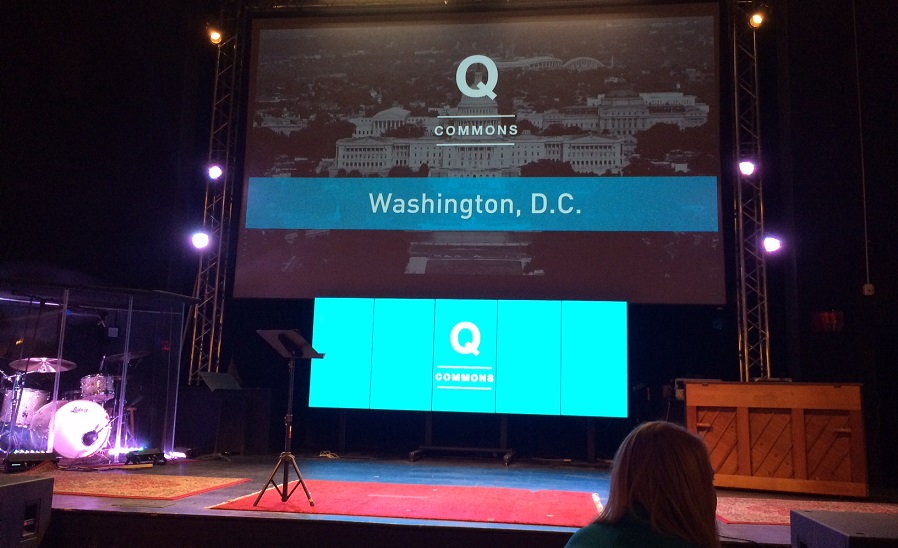
Guinness spoke September 24 during Q Commons, an evangelical conference series telecast to several dozen sites across the United States and overseas. Begun ten years ago as a project of Evangelical author Gabe Lyons, Q is frequently compared to TED Talks with a format of short, timed presentations and a focus on cultural engagement.
Guinness’ talk was followed with a presentation by Cognitive Neuroscientist and Communication Pathologist Dr. Caroline Leaf and a panel featuring Compton, California Mayor Aja Brown, Catherine Davis of the National Black Pro-life Coalition, Physician and Ebola survivor Dr. Kent Brantly and Patricia Mouamar of World Vision. Each of the brief talks and interviews was intended to touch on a recent development that has consequences for the Christian church.
Getting Along, Despite Differences
Declaring Christians to be the “pioneers of religious conscience and religious freedom,” Guinness noted that Christians have also been some of the worst perpetrators against freedom of conscience because of historic events such as the Inquisition. Christians, however, have been recently targeted on a widespread basis more than any other group.
“Wherever there is persecution, in almost every place Christians are persecuted too,” Guinness asserted.
The author of The Case for Civility and The Global Public Square outlined three points: first, Christians need to affirm and appreciate the “foundational primacy” of freedom of conscience and religious freedom.
“It’s under a cloud today, dismissed as a cover for discrimination, religious bigotry or hatred,” Guinness assessed. “But it is the first of the political rights. If you work out the logic of each of the rights, freedom of association depends upon freedom of speech. Freedom of speech assumes and requires freedom of conscience. When the inner forum of a conscience is respected, then the outer forum of the public square can be protected, too.”
Charging that religious freedom is “the key to civil society” Guinness added that in order to have the trifecta of diversity, harmony and liberty, religious freedom is essential. Contrasting two extremes of a “sacred public square” in which a preferred religion is given prominence such as in Iran, or a “naked public square” where all religion is strictly excluded as in North Korea, Guinness identified a third position, the “civil public square” where religious freedom is guaranteed for everybody.
Guinness named three “R”s: rights, responsibilities, and respect so that people know how to differ agreeably, not violently or coercively.
The Trinity Forum founder also said it is necessary to work hard for civility in public life. Guinness insists that we need a massive understanding of and restructure of religious freedom.
“It is not freedom for the religious: it is freedom for all religions and all worldviews – religious or secular, transcendental or naturalistic,” Guinness defined. “It is the fundamental anchor by which bigotry runs aground.”
Arguing for a re-opening of public square, Guinness charged that instead of those who want to drive out religious voices, we need to open the square to all voices.
Noting that “freedom is never a product of law alone,” Guinness called for the renewal of civic education. Quoting French political thinker Alexis de Tocqueville that freedom is a product of “habits of the heart,” Guinness explained “it’s when parents teach their children freedom” and lamented that many countries have seen less civic education for the last 50 years.
“In our postmodern world, with all the culture warring that is going on, we are seeing the maximum chaos, the maximum conflict and the maximum controversies: they are disastrous,” Guinness observed. But, the author asserted, humanity has a stake in it. “We each have to so think, so speak and so live in private and in public that it may be said of us as it was said of King David many centuries ago, ‘he served God in his generation’ and how we live with our differences is crucial in our time.”
Why Thoughts Matter
Where your mind goes, your brain follows, according to Neuroscientist Caroline Leaf. The author of Switch On Your Brain spoke about the concept of neuroplasticity, the idea that our mind can change our brain.
“As you direct your mind, so you start changing your brain,” Leaf reported, noting that by the mid-1990s it was accepted that the mind could change the brain. Quoting 2 Corinthians Chapter 10 verse 5: “take every thought captive to obey Christ,” Leaf addressed the dramatic decline in mental health.
Leaf, who holds a PhD in Communication Pathology specializing in Neuropsychology, has studied and researched the mind-brain connection since the 1980s.
‘Throwaway’ Culture
Leaf’s presentation was followed by a current events panel centered on the value of human life.
“What is happening within our culture, where it has become a ‘throwaway’ culture, and we don’t think as much about human life in the womb all the way to death?” Lyons asked, opening the panel discussion.
Mouamar of Christian relief and development organization World Vision shared her story as a refugee during Lebanon’s civil war, a country that now hosts 1.2 million refugees in a total population of 4 million.
“The reality is that there are 12 million people affected by the war in Syria, and four million have fled to neighboring countries,” Mouamar explained. Noting that some refugees have sought sanctuary in Europe, the World Vision staffer reported that only about 5 percent of worldwide refugees have resettled there.
Half of all refugees are children, Mouamar explained, and many have been without schooling during their exile.
“We are looking at a whole generation that are without an education, children that will one day go back to Syria,” Mouamar predicted. “What kind of generation – what kind of leaders – are we leaving behind?”
Mouamar was followed by Compton, California Mayor Aja Brown, identified as one of the youngest mayors in the United States. Asked about the tension between the African American community and police, Brown addressed Compton’s renewal from crime and violence in the late 1980s.
“When we think about policing and the racial tensions that are really prevalent across the country it is really a symptom of a much deeper issue of ‘do we respect all human life equally?’” Brown summarized. “What we’ve been focusing on is strengthening the relationship between law enforcement and the community.”
Highlighting community events and programs that bring law enforcement into close contact with residents, the Compton mayor declared “It’s all about respect.”
“If we don’t respect one another, then there is no way to form a relationship,” Brown stated.
Asked by Lyons how the church should think long-term about moments of racial tension such as the recent Baltimore and Ferguson, Missouri violence, Brown advised churches to “get outside” and plan programs around tutoring, repairing homes and relationship building.
“[City residents] know that when there is a time of crisis. ‘I can go to that same place where I always get help’ and they will look to that pastor as a leader,” Brown explained.
Asked to address the controversy of the Planned Parenthood videos released by the Center for Medical Progress, Catherine Davis of the National Black Pro-life Coalition shared her story as a post-abortive woman.
Paralyzed with guilt over her two abortions, Davis was prayed for by her pastor “not until I got a release, but until he got a release that I was going to be okay.”
Davis’ pastor gave her a copy of George Grant’s book The Legacy of Planned Parenthood.
“It was at that moment that I realized how abortion in America is not about a woman’s right to choose when it comes to Planned Parenthood. Abortion in America is about population control.”
Explaining Planned Parenthood founder Margaret Sanger’s eugenics views, Davis recalled Sanger’s Negro Project, which aimed to recruit African American ministers in order to promote birth control in order to reduce population numbers.
“Because she felt black lives had no value,” Davis said of Sanger. “Planned Parenthood is the leading abortion provider in America. They do 327,000 abortions a year in this country. They have changed their business model so that every one of their affiliates must do an abortion of some sort.”
“The reason that we know it is an ethnicity-motivated action is that 79 percent of their surgical facilities are located within a two mile walking radius of a Black or Latino neighborhood.”
“The lion’s share of babies they are selling are Black and Latino babies, and they are doing it whether they have the consent of the mother or not.”
Physician Kent Brantly, who contracted Ebola in 2014 while serving in Liberia, spoke about his infection and why he went to West Africa.
“It was our faith that motivated us to move to Liberia to serve people in great need,” Brantly shared. “It was that same faith – that calling to love our neighbor as ourselves – that led us to stay when Ebola came into our neighborhood.”
Reporting that Liberia is now Ebola-free, Brantly noted that Sierra Leone is still experiencing new cases as part of a long-running outbreak.
Asked by Lyons if he had a great fear of death, Brantly told of his anxiety at seeing his symptoms mirror those that he had seen in patients earlier. “That faith that really drove me to Liberia in the first place gave me a great sense of peace. It is beyond my understanding how I could have peace in the face of death, but that I was using my life to live out God’s calling to love him and love other people.”
Lyons praised Brantly for his self-sacrifice, observing that it stands “in stark contrast to the culture today, where life doesn’t matter as much, whether it’s in the womb or in discussion around end-of-life euthanasia – and yet you gave of your life.”
No comments yet



Leave a Reply