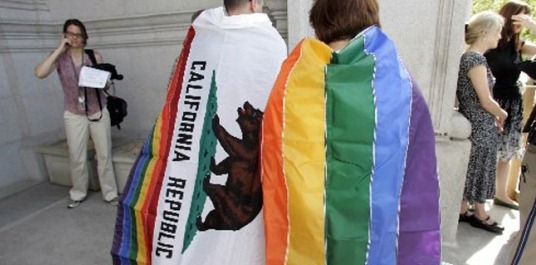
The California state senate and legislature recently passed a bill that would ban sexual orientation conversion therapy (SOCE) for minors if Gov. Jerry Brown signs it into law.The bill to ban SOCE (SB 1172) was written and sponsored by California state Senator Ted Lieu, who accuses such therapies as being “child abuse.”
The law would affect licensed psychologists and professional therapists, not unlicensed counselors and therapists often associated with churches. Lieu claims corrective therapy leads “in some cases to patients later committing suicide, as well as severe mental and physical anguish.” He also accuses SOCE as being “unscientific” and illegitimate because “An individual’s sexual orientation, whether homosexual, bisexual or heterosexual, is not a disease, disorder, illness, deficiency or shortcoming.”
In reality, though the scientific consensus on both the cause of homosexuality and the possibility of “recovery” or “conversion” is undefined. There certainly are tragic cases of teens who struggle with homosexuality and experience deep depression, or even commit suicide because they feel so desperate in their situation. In some cases, a negative encounter with SOCE may have been a contributing factor.
But the American Psychological Association’s 2009 study on SOCE found no solid scientific evidence linking homosexual conversion therapy and suicide. Nor did they find evidence that such therapies are consistently successful. In fact, the study reports: “there is little in the way of credible evidence that could clarify whether SOCE does or does not work in changing same-sex sexual attractions.” Even this scant evidence is more than 30 years old, as there have been no thorough studies on the practice since 1981. Just as there are anecdotal reports of harm resulting from SOCE, there are also plenty of individuals who find it successful.
If signed into law, by default a “gay-affirming” approach would be the only option for parents seeking professional therapy for children (more likely teens) struggling with homosexuality. Further, licensed psychologists and professional therapists would face disciplinary action if they provided SOCE to a minor even if both the patient and parents consented. President of California based Pacific Justice Institute, Brad Dacus explained, “We are one giant step closer to seeing one of the most chilling suppressions of speech yet in the never-ending LGBT push to silence opposition. This is clearly no longer about civil rights—it is about eradicating traditional values.”
Because of the complete absence of scientific evidence supporting the harms SB 1172 purports to address, it seems the bill’s supporters are attempting to stifle any dissent to their belief that homosexual tendencies are an inherent part of one’s identity. Licensed Christian therapists will no longer legally be able to offer therapy in line with the redemptive truth of the Gospel.
Further, it is unlikely it will solve the problems it intends to, as unlicensed therapists and counselors – often associated with churches would remain unaffected by the law. Much of the evidence and stories motivating this bill were, in fact, from this sort of therapy. Given the choice between a licensed professional therapist who will encourage homosexual tendencies and an unlicensed counselor who will practice a version of SOCE, parents who firmly believe homosexuality is immoral will choose the latter. Based on purely anecdotal evidence, the bill assumes that all minors dealing with homosexual attractions wish to accept those tendencies, and parents are engaging in “abuse” by electing therapy that aligns with their beliefs.
This bill is the first of its kind in the United States and LGBT groups are applauding it, no doubt hoping it will set a precedent for other states. There is also no doubt this poses a serious threat to religious freedom and further solidifies the illusion of a scientific consensus that homosexuality is an inherent component of one’s nature.




Comment by Tom Arr on September 5, 2012 at 6:22 pm
Cue Brett Blatchley.
Comment by J S Lang on September 5, 2012 at 6:54 pm
It didn’t take long for “Don’t impose your morality on society” to morph into “Don’t impose your morality on your own child.”
Comment by pa on September 5, 2012 at 11:30 pm
You are worried that, if put into law, “by default a ‘gay-affirming’ approach would be the only option for parents seeking professional therapy for children.” However, you present no evidence for thinking that the only forms of professional therapy are 1. SOCE or 2. gay-affirming therapy. Here’s an obvious possibility (and one widely implemented in therapy): forms of therapy that are evaluatively neutral on same-sex relationships and the like. Further, you’ve given no reason to doubt that some/many forms of non-SOCE therapy can still help patients struggling with issues surrounding sexual identity and may even indirectly help the patient change if that is their goal.
You also claim that “But the American Psychological Association’s 2009 study on SOCE found no solid scientific evidence linking homosexual conversion therapy and suicide. Nor did they find evidence that such therapies are consistently successful.” This is a misleading if not mistaken summary of the report. First, the conclusions are more solid than you represent. E.g., the report “concluded that efforts to change sexual orientation are unlikely to be successful and involve some risk of harm, contrary to the claims of SOCE practitioners and advocates.” (7) “Unlikely to be successful” and “involve some risk of harm” are pretty clear and strong, especially coming from a meta-report in clinical psychology.
Worse yet for your argument, the report include meta-surveys on both adults and children/adolescents receiving the treatment, and the conclusions in study on the effects of SOCE on the latter (to which the bill is directed) are considerably more definitive: the report states that “no research demonstrating that providing SOCE to children or adolescents has an impact on adult sexual orientation,” “no evidence that psychotherapy provided to those children had an impact on adult sexual orientation,” “no evidence that teaching or reinforcing stereotyped gender-normative behavior in childhood or adolescence can alter sexual orientation” (12). The report also states that: “many [therapy programs] do not present accurate scientific information regarding samesex sexual orientations to youths and families, are excessively fear-based, and have the potential to increase sexual stigma. These efforts pose challenges to best clinical practices and professional ethics, as they potentially violate current practice guidelines by not providing treatment in the least-restrictive setting possible, by not protecting client autonomy, and by ignoring current scientific information on sexual orientation. (12) This is likely to be as strong a denunciation of a form of therapy as you are going to find in clinical psychology it seems to me.
Your consequentialist-esque worry at the end sounds legitimate, but one might take it as evidence that parents should be prevented from pursuing forms of unlicensed SOCE on children, against their will. Or, at least that in any court the child’s wishes (not to pursue SOCE) should trump that of the parents.
So I remain unconvinced by your argument against the bill.
Comment by Dan Trabue on September 7, 2012 at 9:24 am
I think PA makes some excellent points that I see are not being addressed.
My question to you would be: Do you really care what the science says, or are you merely using that as an excuse?
That is, IF the scientific consensus was that research supported the ban on SOCE as abusive/detrimental to health, would you then say, “Oh, okay, if that is what the research supports, then I will join in the opposition to SOCE…”?
For many on the Right that I’ve heard speak/write on this, the science is helpful IF it supports their arguments, but if it disagrees with their pre-held cultural values, they disregard the scientific evidence.
So, how about it? IF the science determines SOCE is harmful, will you join in opposition to its use?
If not, then it is a bit disengenuous of you to appeal to science when you think it might help your position, is it not?
Comment by Kristin Rudolph on September 7, 2012 at 10:06 am
PA and Dan:
Yes, I understand that the American Psychological Association has some pretty unfavorable views of SOCE and has issued recommendations against its use based on some of their findings. To me, though, this is not a matter of whether SOCE is proven to be completely successful or not. It’s a matter of proportionality. To ban something is a drastic, heavy-handed approach. There really must be firmly established, causal harm resulting from whatever is being banned to justify such a law. That evidence simply isn’t there with SOCE.
The reality is, yes, there are teens who grow up in Christian (or otherwise religious) homes and realize they have same-sex attractions which causes serious psychological and emotional struggles. It’s difficult to say what factors lead to anyone choosing suicide, and a bad experience with SOCE for some may have contributed. That is absolutely tragic, yes, but I suspect there are many other causal factors that lead to suicide, and this ban would not solve those issues.
The jury is still out on understanding sexuality and what causes same-sex attractions, if they can be changed or not. At the very least, it is premature to implement a ban stating that change is not possible, is harmful to attempt, and is even “abusive.” Not to mention, it is a slap in the face to those who have found such therapy successful.
Comment by Dan Trabue on September 7, 2012 at 10:09 am
And so, IF the evidence is eventually there (if it’s not already) that SOCE is harmful, THEN you will agree that we should oppose it?
Or, if I were to present evidence to you of the harm caused by SOCE, you would then oppose it?
Or does this appeal to science only go so far as it doesn’t conflict with your cultural values? (That’s not an accusation, it’s an honest question – thanks.)
Comment by Dan Trabue on September 9, 2012 at 8:34 am
As always, the silence is quite telling.
If you can’t or won’t answer these sorts of questions, you should not be surprised that you are losing (have lost?) the argument.