Bishop John Bradosky, of the North American Lutheran Church, delivered the following address at an Association for Church Renewal meeting in Washington, D.C.
Thank you for this opportunity to speak with you. I have been made aware of your work through Pastor Mark Chavez and your inclusion of Lutheran Core as one of those bodies working for renewal in the ELCA. We are in this together.
What is the honest assessment of our current state?
Let me begin with the obvious because it remains hidden from the full view of our people and is a source of celebration in our current cultural and political climate. Mainline churches are in a state of decline. The only thing that separates us is the slope of that decline. If you compare our statistics to population growth we are in far worse shape than our year to year decline would lead us to believe.
Baptists of all types are not far behind and if you are one of those who enjoys the phrase, “misery loves company,” you will be pleased to know that other evangelicals, even the independents, will be joining our ranks soon. Christianity in North America is in a state of decline!
What are the root causes for the decline?
- The focus on achieving “relevancy” started with an invalid assumption. The Gospel of Jesus Christ depends on us to make it relevant to the culture. The mission of the church was diverted from the Great Commission or the Great Commandment to the agenda of the culture. By promoting the agenda of the culture some believed the culture would then be able more open to the mission of the church. However, as the church abandoned its mission in favor of speaking out for the culture, there was no need for the culture to respond to the church, because the church now adopted the cultural values as its own. The church became mired in the political as a means to attain popularity. Political agendas and activism became the means for demonstrating relevancy. But the result was a church that became less popular and increasingly irrelevant to the culture.
- One of the specific cultural values that undermined the authority, mission and ministry of the church is the preoccupation with evolution and the theory that became dogma, regarding the progress of humanity towards positive change, sophistication and therefore superiority over our predecessors. The present is far more valuable than the past. The values, ideas, life-style, philosophies and lack of religious faith in the present is far superior to the past. The hermeneutic of present is skepticism for anything in the past.
- The sense of the transcendent gave way to the systems of salvation we could manufacture for ourselves. Science, technology, medicine and politics led the way. Rather than discuss the nature of the Kingdom the church was content to settle for socialism or communism, depending on denominational line. Today there are still many who believe the kingdom of God, Jesus proclaimed will be ushered in on the political platform of, Democrats, Republicans or Independents. Social engineers and educational systems would take the place of the church in setting values. Government would take over the responsibilities for caring for the poor and hungry, the widows and orphans, the sick and dying.
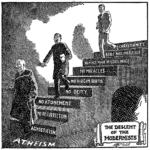
- Internally the church adapted by abandoning the authority of Scripture. In order to validate the values of the culture we had to also abandon the historic interpretation of the Scripture. Seminary professors in the name of “historical-critical method” were free to engage in deconstructive methods of interpretation, revisionist methods and reductionist methods or Gospel minimalism. Those methods obscured the nature of the Christ. Forgive me for quoting Luther here. Luther wrote, “Let the Bible cease to be heard and soon the remembered Christ becomes an imagined Christ, shaped by the religiosity and the unconscious desires of his worshipers.” “The authority of the Church becomes nothing more than the wisdom of popes and councils…” Luther understood that without adherence to the Word, the remembered Christ becomes the imagined Christ that fits our agendas and issues. The mission Jesus gave to his church is abandoned for the new mission of cultural relevancy and evangelism that leads people to Christ is abandoned for the sake of leading people to embrace the “cause.” The freedom to redefine sin according to the new values of the culture meant that forgiveness and repentance were also considered unnecessary. The new authority and driving force were feelings and personal experiences. A savior who offers forgiveness and salvation were once important but now, no longer necessary.
- What has preoccupied us for decades is teaching the content of issues and agendas rather than the faith. It is no small concern that our people know more about environmental issues than they do the life of Jesus. We know more about political issues than our confessions. We know more about the economy than we do about ecclesiology, the nature of the church. We know about social ills but very little about the spiritual ills that plague us. We are aware of world hunger but care little about helping others hunger for God. We are aware of our need to conserve water resources but fail to lead others to the well spring of the water of life, Jesus. We talk about freedom but say little about obedience. We focus on Grace but don’t see the value of repentance and transformation.
- The over–institutionalization of our churches has worked to hasten our decline. We have adopted a corporate model requiring the upward flow of power, money and control to the uppermost levels of our structures, depending on those at the top to address the problems and concerns, to produce the changes necessary for renewal and rebirth. What they have succeeded in doing is to suck the life out of the local congregation. The front line for mission and ministry are those stuck in bureaucratic offices who have the least contact with those in need. They are the least effective in delivering what is helpful, but use every contact to promote the values of their internal culture and insist on conformity with their agendas. As they continued to fail, decreasing in size and financial assets, they resorted to what every dying institution does.
- Institutional survival has now become the mission. Preserving their existence becomes the most important goal, even if it means compromising the Gospel. Evangelicals who overbuilt their infrastructure are forced to fill the seats by making their message popular. The easiest way to do so is to compromise the Gospel for the sake of a more popular message that is sure to please. The characteristics of institutional survival are defensiveness, deceit, attacks, creating new enemies to blame for failure, and protection strategies. Denial of the truth and maintaining images are everything.
How did we get to this point?
Whenever I speak about this the most frequently asked question is how did we get to this point? We have to have a reasonable and plausible answer for such questions. My stock answer is this just a little at a time. George Barna addressed this concern some years ago in his book, The Frog and the Kettle. This concept of social change is called gradualism. As a pilot I understand the nature and use of the compass. That analogy is also a good way to describe our situation. If you are only off a few degrees and you are only going five miles you will still hit your target. If you are only off a few degrees and you are going 500 miles you could miss an entire city. If you are off a few degrees and you are going 5000 miles you could miss an entire state or two. This methodology for change is imperceptible but intentional. Those advocating it have a consistent mantra, why are you worried about the little things? This is insignificant. It won’t affect you. You are making a mountain out of a mole hill. By the time we realize how far off course we are it is too late!
Where do we go from here?
- Staying or leaving is not the main issue.
- Whether people stay or go, we must admit that renewal can’t happen without reform.
- Reform is not going to come until the pain of continuing down the current path is greater than the pain of changing.
- People cannot stay on the front line of such conflict forever. This is a battle. People are being attacked and left demoralized. They are shell-shocked and suffering from fatigue.
- While renewal groups can be a safe place for people to share their war stories and pray for one another’s war wounds, they will not be able to hold people together endlessly.
- People need a place to go to be immersed in faithful service, mission and ministry that is bearing fruit.
- As a result I think renewal groups are going to have to be a place where the front line has to change regularly. Offering fellowship, sharing, encouragement, spiritual renewal are good, but the development of a battle plan is even better.
The NALC has developed a church culture based on four basic values:
Christ Centered – Jesus is everything and the only one we follow is the Christ revealed in the Word. We uphold biblical authority, as the norm for all matters of life and faith, the revealed and transcendent truth. Our Theological Conference in August was titled, “Salvation Today” with the keynote address: “The Uniqueness and Universality of Jesus.” It was so essential because through these last several decades, both pastors in their seminary training in congregations through the preaching of those pastors, our people have become confused regarding salvation! Jesus is unique, exclusive, definitive, normative and absolute. There is no other savior or means of salvation apart from Him. This is countercultural in a pluralistic world, yet it is the truth.
I am reminded of the story of a thirsty cowboy who walked into a saloon. The bartender said, “Care for a drink, stranger?” The cowboy responded: “What are my choices?” The Bartender answered: “Yes, or no.” (Leonard Sweet Soul Tsunami) In a world that wants all kinds of choices, we have a singular focus on Jesus because there are no other choices. There is only one Lord, one Savior, Jesus!
The second value of the NALC is Mission Driven. We believe the great commission is the only mission Jesus gave to his church. We are to make disciples of all nations, baptizing them in the name of the Father, Son and Holy Spirit, teaching them to obey all that Jesus commands. We are not defining ourselves in a negative sense by what we oppose rather we are looking forward to doing everything we can to fulfill the great commission.
The third value is that we are Traditionally Grounded. We affirm the ecumenical creeds and the faithful witness of the Church across time and space. We seek dialog and fellowship with other Lutheran churches and with faithful Christians of other confessions. We are not trying to reinvent the Church but remain faithful to the heritage that has made Lutherans a blessing to the entire body of Christ. We are a part of the legacy of those countless saints who came before us who gave their lives for the sake of the Gospel of Jesus so that we might know Him and worship him and follow him by sharing His Gospel until the whole world knows.
The fourth value is that we are Congregationally Focused. The local congregation is the front line for mission and ministry. Everything else we do organizationally should be to support, facilitate and encourage the ministries of local congregations. We will be lean and structure ourselves so that we can keep pastors and congregations connected for best practices, best ideas for ministry, sharing resources, offering support and care, etc. In so doing we have abandoned the corporate model of the upward flow of money, power and control and empowered local leaders and encouraged the development of ministry and mission at the place where it will do the greatest good.
In short we see ourselves as a part of the Confessing Church Movement. For those of you who have not read it yet, I commend the biography of Dietrich Bonhoeffer by Eric Metraxis. Bonhoeffer was a pastor and theologian during World War II. He was a leader of the Confessing Church movement in Germany that opposed the German Church. The German Church had been conscripted by the culture and the authority of political leaders like Hitler and others, such that it was willing to compromise the truth for the sake of its own survival. As you read it I believe you too will be struck by the similarity in the issues the church was facing then and what we are facing today. The need for the confessing church has never been greater.
Bonhoeffer decries the cheap grace the Lutheran Church of Germany was offering people. He describes discipleship with these words: When Christ calls someone; He bids them to come and die.
Bonhoeffer is reminding us that the cross of Christ, His sacrificial love for the salvation of the world must be manifest in our own lives. Christ’s love and constant presence give us the capacity to give our life away. It is at the cross that sin is forgiven, salvation is received and new life begins. Discipleship is complete commitment to Jesus. Every part of our life has to die. Our sin, our pride, our worry and concerns, our selfish desire, our materialism, our commitment to buildings, organizations and institutions all have to die. The only way that you can truly experience life, is to die. It is only through dying that we truly live. Bonhoeffer held on for as long as he could but in the end had to leave the German Church to lead the Confessing Church movement. The issue of staying or leaving has to give way to the greater concern of boldly confessing Christ even in the hostile environment of the institutional church culture or the American culture!
Where is the hope for our future?
There is hope. Christianity is still the fastest growing faith in the world. It is just not growing in the West or the Northern Hemisphere. It is growing in the East and in the Southern Hemisphere.
In my trip to Ethiopia this past February and in subsequent dialogs with leaders from Ethiopia I have learned several important things regarding the success of the church regarding growth, evangelism and mission. Ethiopia is a place where the church is growing faster than any other place in the world. Here is the surprise, Lutheran are at the forefront of that growth.
What they have confirmed as reasons for that growth in the Ethiopian Evangelical Lutheran Church Mekane Yesus, are these:
- Complete reliance on the power and work of the Holy Spirit
- Essential nature of prayer
- Personal ownership for the Great Commission – The real vocation of every Christian is to fulfill the Great Commission. Everything else you do with your life is an avocation that serves your primary purpose. Let me give you an example. Allamu – construction company – Chapel trailer – two pastors – devotions – local labor and Muslims – pastoral work – new congregation – 49 before I left – getting into trouble with the government – took me to his car opened the trunk – box of bibles half empty… minister of commerce meeting… No sense of political correctness – personal responsibility for the great commission.
- Bold proclamation of the Gospel – uninhibited by the culture or political correctness
- Believing use of the Scriptures – Normative
- Salvation in Christ alone – no other means of salvation
- Focus on Discipleship – following Christ obediently
- Connect acts of love and care with the sharing of the Gospel – symbol of the dove
- Lay involvement is not only important but essential – primary areas of responsibility – catechists – evangelists – pastoral assistants – caring ministries – etc. Demonstration of the priesthood of all believers
10. Mentoring and Education – (they want to learn more)
11. Trusting in the Hand of God to work not our own hands (our hands respond to Him and we place our hands in His)
12. The best news of all: they have a mission to reach the world with the Gospel of Jesus and that includes us!
We need one another. We need to work together to strengthen our witness to the world. Just returned from Rome, where I was amazed at the sensitivity to work together to overcome the passive acquiescence of the church to cultural values that have watered-down or destroyed the faith of those who were once faithful. I was amazed at the honesty about the inherent problems of institutionalization that weakens or diverts the focus of faith in Jesus. The new ecumenical movement must not be simply mutual support or understanding our difference, but a new commitment to unite under the banner of the Confessing Church Movement, to boldly confess Christ. It is to that end that we must labor and commit our lives.
May the Lord continue to bless and guide you in your work.
Thank you.
No comments yet



Leave a Reply