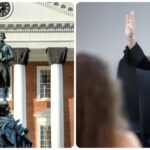
Jim Wallis (left) and Geoff Tunnicliffe (right) lament the U.S. government’s “traditional” response to the 9/11 terrorist attacks. (Photo credit: World Evangelical Alliance) |
Commemorating 9-11, liberal activist Jim Wallis of Sojourners announced at a World Evangelical Alliance (WEA) and Sojourners sponsored press conference at Ground Zero that he is “feeling proud today to be an evangelical.” But he also denounced the U.S. for its War on Terror since 9-11.
At the September 9 press conference, “global Evangelical leaders [called] for peace and unity” with the focus on better relations with Muslims. A pacifist, Wallis is inspired by “a whole new generation” of believers “who will follow the nonviolent way of Jesus.” In his Huffington Post article, Wallis detailed his hope for the “new generation” that grew up in the decade following 9/11. He wrote that a “new generation of Christians has asked how Jesus would respond” to the events of 9/11. They have turned to “alternative responses” instead of “the arrogance of American power,” Wallis enthused.
Wallis admitted that “terrorists offered a stark view of the world they would create, where the remedy to every human grievance and injustice is violence and oppression.” But he lamented the U.S. government chose a “martial” response to 9/11 instead of embracing the “new generation’s” pacifism and the first responders’ neighborly love. He praised the unquestioning assistance first responders of 9/11 gave each other. And he explained that “everybody was their brother’s or sister’s keeper” in the aftermath of that tragic day, “overcoming of evil with good.” But since then, America has had “a whole decade now of war … which has now changed the reputation of our nation.”
“America must be a safe place for all our citizens in all their diversity,” Wallis insisted, referring to treatment of Muslims in the U.S., but not evidently to safety from terrorist attack. He explained, “When we protect and respect those who share national origins, ethnicity, or religion with those who attacked us, we model for the world the best America has to offer.” Unfortunately, Wallis explained, this agenda has been derailed because “our government reached for its traditional ways of responding” which “led us down a spiraling path.” He has hope though, in the “new generation reaching for something else.”
Wallis also blamed “bad religion” as a “cause of conflict” in the world. Citing New York Mayor Michael Bloomberg’s exclusion of clergy and formal prayers at the New York City 9/11 memorial ceremony, Wallis said that “complaining about not being on stage is not part of unity.” He said “the answer to bad religion is not to have no religion or exclude religion entirely, as some have done, but to practice and preach better religion.” He claimed that conflict among Christians, Muslims, and those of other faiths is “a generational issue,” and that “we’ll see a shift in the days ahead.” Wallis further claimed that “we’re trying to clarify the witness of Christ in the world.”
World Evangelical Alliance (WEA) General Secretary Geoffrey Tunnicliffe also had no strong objections to New York’s religious exclusion on 9-11, saying the memorial “is a place of healing,” and pushing for religious representation would disrupt the healing process. In the years since 9/11, he said, “we have seen increasing fear, insecurity, profiling and racism.” WEA “is committed to work with others in helping draw new maps that will help guide us into a new world where there is greater understanding, mutual respect and shared concerns for the challenges faced by all of humanity.”
Tunnicliffe also mentioned the disparity between age groups, as “9/11 profoundly changed the world for an entire generation.” Since 9/11, he has seen a “growing acknowledgment within our global evangelical community that we must build bridges of friendship and trust across ethnic, cultural, and religious divides.” He spoke at the press conference to urge evangelicals to find ways “to create a better world that is more hopeful,” with “greater understanding, mutual respect,” until “love for our neighbor in this global village becomes preeminent.” Tunnicliffe urged Christians to “be instruments of reconciliation in a world torn by war and conflict.” Without detailing his own foreign policy views, he said that “faith and religion must be taken into account when developing international policy,” adding that the WEA stands “ready and willing to engage in dialogue with any government to promote greater peace, respect and freedom.”
Wallis and Tunnicliffe expressed high hopes for the “new generation” and its “alternative responses” to violence. They did not acknowledge that enemies of the United States are unlikely to cooperate in the pursuit of a peaceful and respectful “global village.” Joining them at the press conference was liberal evangelical David Gushee of Evangelicals for Human Rights (EHR) and the New Evangelical Partnership for the Common Good. Gushee is an outspoken critic of U.S. terrorist interrogation and detainment policies.
No comments yet



Leave a Reply