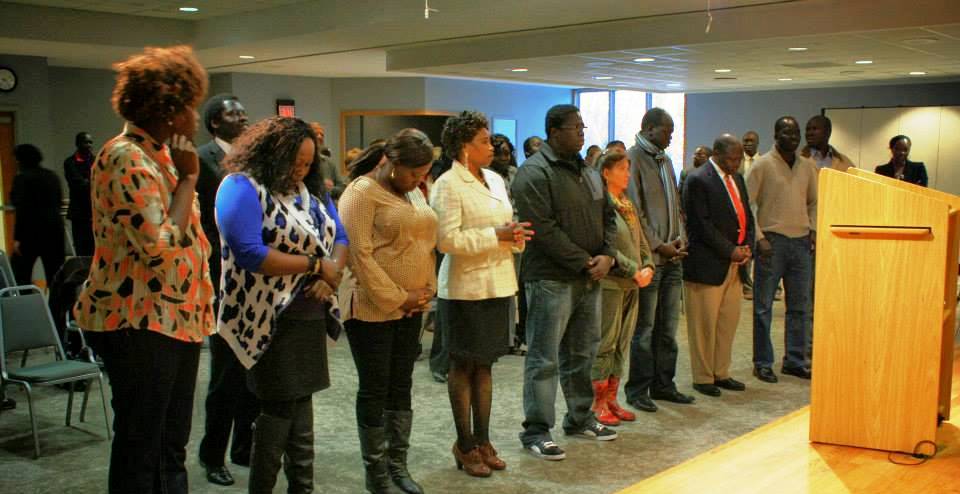
On Saturday, January 4, dozens of members of the South Sudanese community in the Washington, DC area came together to pray for South Sudan. Organized and led by Kwathi Ajawin, the Prayer Vigil for South Sudan was held at Cornerstone Church in Annandale, Virginia. In addition to South Sudanese representing all ten states of South Sudan, and friends of South Sudan of various nationalities, prayers leaders included Ethiopian and Kenyan pastors, as well.
There is much for which to pray.
Over 1,000 people have been killed and 200,000 displaced by three weeks of deadly fighting between troops loyal to South Sudan President Salva Kiir and those loyal to former Vice President once again turned warlord, Riek Machar. The fighting has been worst in the South Sudan capital of Juba where it began in the army barracks on the evening of Sunday, December 15, and in Bor, the capital of Jonglei State, but it has also spread to several other states.
The Voice of America website provides a day-by-day account of both the fighting and the progress of peace talks between the warring factions. But neither military might nor political power ultimately can deliver South Sudan from war.

Only the Spirit of God can change the hearts of the people and bring about the forgiveness and reconciliation necessary for peace and for South Sudan to move forward once again. For although many analysts and journalists are eager to deny that the conflict is tribal in nature, they are only half right.
What is now unarguably (and in all probability was from the beginning) a coup attempt by Machar, and a dissatisfaction with many actions taken by Kiir, has led to defining the conflict as “political” at the root. But there is another root problem in South Sudan.
In the Bible, Hebrews 12: 15 warns us to watch out that “no root of bitterness” springs up to cause trouble and “defile many.” The writer was referring back to Deuteronomy 29: 18 that warns against the hearts of people turning away from the Lord to worship idols. “Make sure there is no root among you that produces such bitter poison,” it says.
Unresolved bitterness, leading to envy, greed, anger, pride, hatred, finally erupted into the violence we are seeing today with one ethnic group pitted against another. Both armies are strong. In one case, a town has gone back and forth from being attacked and controlled by Machar’s troops to being brought back under the control of the South Sudan government troops three times in three weeks. Once again, the civilian population of South Sudan suffers as the mighty vie for power. As the East African proverb says, “When elephants fight, it is the grass that suffers.”
Since the crisis began, the suffering people have had a voice in South Sudan’s church leaders. Church leaders from every denomination and ethnic group have been continually pleading for an end to the fighting that threatens the future of the world’s newest nation.
On December 17, church leaders held a press conference in Juba, and issued a message of peace and reconciliation. They warned that whatever had happened in Juba over the past few days, they were worried about the consequences — for the people individually, for the nation, and for relations with other nations. After issuing both pastoral and practical advice, they concluded the press statement noting the coming Christmas celebration. They said: This year’s Christmas may not be what we expected, but it is what we have been given and we must accept it as it is. As we celebrate the birth of the Christ-child, let us remember that God is with us, and pray for the strength and courage to bring peace, reconciliation and healing to our new nation.
The next day, a larger group of clergy released another statement, identifying themselves not as representatives of any tribe or denomination, but as “leaders and representatives of one Church and one Body of Christ.” The church leaders and other clergy appealed to the people, particularly to the Dinka and the Nuer, “not to accept that the conflict is between the two tribes.”
We will be posting more about the South Sudan crisis in the next few days, including ongoing statements by the Church, as it fulfills its prophetic and pastoral role of representing the cries and the needs of the people of South Sudan and as they issue more calls to prayer. Please pray with them for an end to the violence, for healing of the root of bitterness, and for peace to return to South Sudan.
No comments yet



Leave a Reply