by Matthew Hamilton

Paul preaching the Gospel of repentance and redemption (Photo credit prayer_bracelet.com)
Pro-LGBT United Methodist minister Trey Hall of Urban Village Church in Chicago spoke last Sunday at Foundry United Methodist Church in Washington DC. Rev. Hall’s sermon at Foundry centered on Luke chapter 10, which tells of Jesus’ commissioning of the seventy two to go out and preach the good news. Perhaps what was most revealing from Hall was in reference to his work at Urban Village to support gay marriage and affirming LGBTs within the United Methodist Church. The United Methodist Church officially affirms sex only within traditional marriage between a husband and wife.
Hall cautioned: “People who do this hard justice work… without a spiritual rooting, quickly can become resentful, dogmatic, a little hyper earnest, fueled by rage sometimes, fueled by that eternal victim mechanism.”
There is a lot more truth in his statement than may first meet the eye. Hall essentially makes a case that people who exhibit resentment, rage, and a victim mentality do not have their work spiritually grounded. By that measure, Exhibit A, which is the work of Missiongathering Church in San Diego, betrays the symptoms of not being spiritually rooted as there is clearly resentment, rage, and a victim mechanism being presented.
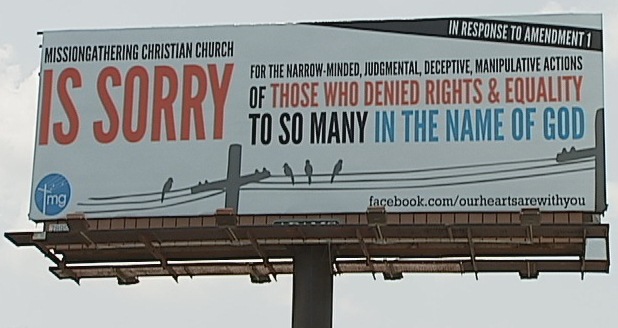
A billboard paid for by Missiongathering Church (Photo credit markelly.wordpress.com)
Faults exist on the far opposite end of the spectrum as well. Exhibit B is a photo of a young member of the infamous Westboro Baptist Church (which is actually not affiliated with any Baptist association and is essentially a family cult centered around Pastor Fred Phelps). While having some different symptoms from Missiongathering, they are rhetorically even more vicious, spiteful, and devoid of spiritual rooting.

Representative of Westboro Baptist’s theology (Photo credit independent.co.uk)
Westboro Baptist is thankfully nearly alone in advocating the heresy that God “hates” LGBTs. It is easily recognizable to most Americans thanks to its obsessive flaunting of their heresy and the equally obsessive media coverage that their antics attract. The media routinely reports on Westboro, although it comprises only a few dozen people. So it is unsurprising that much of the Religious Left and many secularists believe that this heresy has the following of a large number of the Christian Right. In reality, of course, this particular heretical view is mostly confined to the media hogs at Westboro Baptist.
But the heretical view of Exhibit A: that LGBT behavior is not only not sinful but merits endless affirmation, is widely held by an immensely larger number of persons in the Religious Left and many prominent persons among United Methodists, Presbyterians, Episcopalians, and Lutherans. While they may be far more subtle than their Westboro Baptist adversaries or their Missiongathering allies, their symptoms of resentment, rage, and victimhood as they have fought both in churches and in the public square have been easily observable by their opponents… and apparently, by some of their allies too.
Both Exhibit A and Exhibit B fail the test of being rooted in God’s word. Exhibit A undoubtedly believes that God loves LGBTs and that God does not see their behavior as sinful, while Exhibit B undoubtedly believes that God hates LGBT’s and that God sees their behavior as sinful. Fact of the matter is that both are partially right and both are partially wrong.
Christians who believe that homosexual behavior is not sinful are committing the heresy of defying the authenticity of the Bible and its God who commanded with no ambiguity:“‘Do not have sexual relations with a man as one does with a woman” (Leviticus 18:22). How dismissal of the prohibition on same sex behavior does not by default ultimately dismiss the veracity of God’s prohibitions on other non-marital sex, incest for example, has never been satisfactorily addressed by Christians who affirm homosexuality and bisexuality. People like Trey Hall are simply cherry picking Biblical passages to match their preconceived notions of sexuality which by definition is both logically fallacious and heretical. In I Corinthians 6:9-10, the Apostle Paul addressed again in plain language the issue of homosexuality and warned against believing those who deny its sinfulness:
“Or do you not know that wrongdoers will not inherit the kingdom of God? Do not be deceived: Neither the sexually immoral nor idolaters nor adulterers nor men who have sex with men nor thieves nor the greedy nor drunkards nor slanderers nor swindlers will inherit the kingdom of God.”
According to the Apostle Paul, people like Trey Hall do not know who will inherit the kingdom of God and are being deceived by a heresy.
Similarly, the crowd at Westboro Baptist claiming “God hates f**s” is also following a heretical teaching. The idea that God hates every LGBT person because of their sexual practices is not Biblically founded. The Scriptures do describe God at times hating. Psalm 11:5 for example says, “The Lord examines the righteous, but the wicked, those who love violence, he hates with a passion.” In the Bible, passages which speak of God’s hatred follow the common trait of His hate being directed at persons who are evil, that is, persons who deliberately pursue what is evil, such as sowers of discord or false witnesses. There is however no Scripture to support the idea that LGBTs inherently possess evil intent. There is also no Scripture to support the belief that a sinner who does not have evil intentions is also hated by God. Therefore, there is no Biblical basis for the claim that God hates LGBTs. What there is Scriptural basis for, is that God’s offer of redemption is for all sinners and does not exclude LGBTs in the slightest.
Trey Hall proclaims that his church in Chicago strives “to be inclusive, and evangelical.” By inclusive he means that they welcome LGBTs to be part of the church, and by “evangelical” he means simply that they preach the good news to non-believers. Hall says that “for Methodists, they’re two sides of the same gospel coin.” However, this particular gospel coin is a lousy counterfeit.
Not once, in all of his sermon, does Trey Hall ever mention the word repentance or anything having to do with the concept. The gospel is not merely preaching the good news that Jesus came to Earth to restore man’s relationship with God. Jesus also came commanding repentance per Matthew 4:17 where he says: “Repent, for the kingdom of heaven has come near.” If whatever gospel Trey Hall preaches does not involve repentance, it is a counterfeit, factory second, broken, and worthless. If the gospel of United Methodists does not involve repentance because they favor being able to call themselves inclusive, it may be little wonder that the UMC in America has continued its downward spiral and shrunk by an additional 72,000 members in 2011 alone.
Those like Rev. Trey Hall who believe the heresy that homosexuality is not sinful are doing the LGBT community no favors. Jesus said in Luke 13:3, “But unless you repent, you too will all perish.” In some regards, they may be just as harmful to homosexuals as the Westboro Baptist types in so far as they espouse heresies that do not lead to redemption. The Gospel is meaningless without repentance, and it is unfortunate that many with good intentions for LGBT people are misguiding them with a counterfeit Gospel. No doubt many are motivated with compassion and a desire to include LGBTs rather than make them feel like outcasts by convicting them of their sin. But is the feeling of temporal acceptance for LGBTs worth missing out on the eternal redemption that God offers?
“What good will it be for a man if he gains the whole world, yet forfeits his soul? -Jesus (Matthew 16:26)
You have your answer.



Comment by Dan Trabue on August 7, 2012 at 12:52 pm
Matthew…
the heretical view of Exhibit A: that LGBT behavior is not only not sinful but merits endless affirmation
Hold on, hold on… “heretical…”? Heretical, HOW? What Gospel essential is denied by disagreeing with Matthew about the sin nature of homosexuality (ie, Matthew holding the traditional opinion that all gay behavior is sinful… what makes disagreeing with THAT “heretical” in any reasonable sense)?
We all disagree about various behaviors. The anabaptists disagree with many in mainstream Christianity about saying pledges/taking oaths/posting flags/going to war… etc. Does that make all the mainstream of Christianity “heretics…”?
The error that keeps happening here is the notion of conflating your opinions about various behaviors with God’s Word and that disagreeing with you all is disagreeing with God and that disagreeing with God is heresy.
The gospel message is that we are saved by God’s grace – NOT by legalism, not by our works, not by our perfect knowledge.
Thankfully for you, Matthew, you can be mistaken and still be saved. Otherwise, I reckon we’d all be in a pinch, eh?
Can you back off this statement or defend it?
Posting such a blatantly unorthodox Christian view in defense of Christian values is a bit ironic and hypocritical, one could argue.
Comment by John McAdams on August 8, 2012 at 12:24 am
Dan,
It is terribly convenient to “interpret” away Biblical prohibitions that have become politically incorrect, isn’t it? If we aren’t saved by “legalism,” does that mean that any old behavior is fine and OK? I’m sure you don’t believe that, and probably believe (“legalistically”) that having too large a carbon footprint, or wanting cuts in Federal spending really are sins that people should repent of.
Comment by Dan Trabue on August 8, 2012 at 7:12 am
Pastor J…
I think you just come here to be abused by others.
That’s an odd thing to think.
Thanks for the conversation. I really would have liked to hear answers to several of my questions that went unaddressed, but thanks for the conversation.
Peace.
Comment by Dan Trabue on August 8, 2012 at 7:19 am
Sorry, That last response was to Pastor J’s last comment.
John, no one that I know is trying to “interpret away” Biblical prohibitions. Any more than you are “interpret away” biblical prohibitions against haircuts, polyester or the Sabbath or Jubilee rules.
Rather, we just don’t think your interpretation of these passages is the most rational/biblical interpretation. We disagree, that’s all. There’s no “politically correct” motivation, just a motivation to follow God.
I’m not questioning your motivation to follow God. Why would you question mine/ours – people you don’t even know? Do you see how that sounds a bit presumptuous and grace-less?
And yes, I believe that materialism and overconsumption (“too large a carbon footprint”) are things to watch out for, rationally and biblically speaking. How does that apply to the topic here?
And John, do you think that Matthew should back off his slanderous false witness (both clearly sins) in his post? Do you think that being mistaken about a behavior rises to the level of preaching a false gospel?
If so, on what basis? Where is your lists of sins that you can’t be mistaken about without preaching a false gospel and being a heretic? What is your support for that list?
Comment by Tom on April 25, 2014 at 3:02 am
“Where is your lists of sins that you can’t be mistaken about without preaching a false gospel and being a heretic?”
Probably the list of things that Paul says are manifestly(obviously) works of the flesh. Homosexuality is one of them.
Comment by Dan Trabue on August 7, 2012 at 1:03 pm
Matthew sort of addresses my question in his post, saying…
Christians who believe that homosexual behavior is not sinful are committing the heresy of defying the authenticity of the Bible and its God who commanded with no ambiguity that sex is for husband and wife.
The error here is…
1. It is NOT heresy to disagree about interpretations of the Bible. We are NOT NOT NOT “defying” the authenticity of the Bible. To suggest that is to bear false witness, to slander and to gossip. I rebuke such behavior, Matthew, in the name of Christ our saviour.
2. We disagree with your interpretation, your opinion of how best to understand the passages in question. Disagreeing with Matthew is not the same as disagreeing with God and to place yourself in that position comes awful close to blasphemy. Careful, there.
3. Further, to disagree with many in the church, or to disagree with human tradition in the church is not the same as “defying” God. We do NOT defy God, we seek God’s will and in seeking God’s will have reached a different opinion about the matter than you. You can say that you think we are mistaken, but you can’t rationally or morally say that we are defying God.
Words have meanings, I encourage you to re-state your position or run the risk of actually openly defying God’s Word (ie, bearing false witness, which is obviously and clearly wrong, biblically and otherwise).
4. God has not “commanded with no ambiguity that sex is for husband and wife.” The Bible is actually a bit vague and open-ended on questions of sexuality. Concubinism is accepted as normative. Polygamy is accepted as normative and the Bible literally has God “giving” David his many wives. The Bible is factually silent on the topic of gay folk marrying and the Bible is abundantly clear that those things that are good, noble, pure, loving, etc ARE good and to be encouraged. It is, therefore, reasonable that some of us can conclude that marriage for all (gay or straight) is biblically sound.
5. Again, you all seem to conflate your opinions and interpretations with God’s Word. At the very least, you should be intellectually honest enough to admit what the Bible does and doesn’t say, and to admit that those who disagree with you are not deliberately disagreeing with God. We COULD be mistaken (just as YOU could be mistaken), but being mistaken is not a heresy. Not in orthodox Christian circles, which affirm the fallen nature of humanity.
Brother Matthew, I encourage you in the name of Jesus to reconsider and re-address these matters in a more grace-full, Christian manner.
Peace, Dan
Comment by PastorJ on August 7, 2012 at 2:07 pm
Dan, what is not an interpretation? The divinity of Christ? The Trinity? Salvation by grace?
And gee, I wonder why the Bible is silent about “gays” marrying each other? C’mon man.
Also, there’s no sense putting up these weak arguments that have already been answered by competent people in a competent way. Most proponets of saying that homosexual behavior is an acceptable Christian practice have already acknowledged that an argument cannot be made based solely on scripture. And that’s why the such arguments are not being accepted (and will not be accepted) by those who hold to the authority of Scripture.
Comment by Dan Trabue on August 7, 2012 at 4:08 pm
Pastor J…
what is not an interpretation?
Well, to be fair, nearly everything is an interpretation, when we’re talking Bible study. What isn’t an interpretation? I’d really like to know.
Pastor J…
The divinity of Christ? The Trinity? Salvation by grace?
These are all obviously interpretations. The Bible does not specifically say anything about the Trinity, for instance. We humans have interpreted that/read the notion of the Trinity into the Bible’s teachings. There is no harm in admitting that these are interpretations, is there?
Again, if they’re not rationally called “interpretations,” what are they?
I think the dealio is that Christians have agreed on some essentials of the faith are as I listed above, more or less (even on the essentials, there is some quibbling, but we’re pretty consistently agreed on them). But holding to a perfect knowledge of all sinful behaviors is not amongst the essentials of the faith. In fact, the suggestion that we ought to have a perfect knowledge in the area of all sins/behaviors, that would be contrary to the essentials of the faith, which state clearly that we are a fallen and imperfect humanity.
Do you think we ought to have perfect knowledge in order to be saved, Pastor J?
Pastor J…
And gee, I wonder why the Bible is silent about “gays” marrying each other?
Probably for the same reason there is no discussion of automobiles or nuclear weapons and why it’s silent in opposition to polygamy: There were no cars, nukes or gay folk trying to get married, as it was counter to the culture of the day, just like polygamy was accepted by the culture of the day.
But that would be an argument from silence, Pastor J, wouldn’t it? (ie, the Bible is silent on gays marrying each other, therefore, it must be wrong… this is poor logical reasoning.)
Pastor J…
there’s no sense putting up these weak arguments that have already been answered by competent people in a competent way.
With all due respect, we simply disagree with your “competent people” and their answers. We don’t find those answers to be credible and, rather than simply bowing down to what others say, we are obliged to do what WE BELIEVE is right in God’s eyes. Agreed? Or would you have us do what we believe to be wrong?
Pastor J…
Most proponets of saying that homosexual behavior is an acceptable Christian practice have already acknowledged that an argument cannot be made based solely on scripture. And that’s why the such arguments are not being accepted (and will not be accepted) by those who hold to the authority of Scripture.
I hold to the “authority of Scripture” and I disagree with your collective hunches on this matter. I’m sorry, but those are just the facts. But my disagreeing with your collective opinons does not make me a false teacher or a heretic, unless you hold to the position that all those who disagree with anything your particular church says is a heretic, but then, by that measure, YOU would be a heretic in my eyes, if I used that measure.
I prefer to embrace grace, sweet grace.
Comment by Dan Trabue on August 7, 2012 at 2:06 pm
Matthew, if you truly believe the (actually heretical) position that one must not be mistaken on the issue of marriage for gay folk or they are heretics, what is your list of other sins that one can’t be mistaken on? War? Use of nuclear weapons? Pollution? Smoking tobacco? Smoking marijuana?
Where is your list of sins that you and others CAN’T be mistaken on without being heretics and where do you find that in the Bible?
You want to hear the word “repent” from a so-called progressive? Repent, my friend. You have stated falsehoods and appear to be holding to a false Gospel. Admit your mistake (it happens, we all make mistakes, no shame in admitting it) and repent. God stands ready to accept and love you, regardless of your mistakes.
Comment by PastorJ on August 7, 2012 at 2:10 pm
Dan, what do you consider to be heretical? How do you define “heresey”? What is your process for concluding what is heretical? How does your process line up with historical church practices?
Can you answer these questions?
Comment by Dan Trabue on August 7, 2012 at 2:40 pm
1. The standard English definition of “heresy” is not what we are speaking of in the church when we speak of heresy.
Heresy: adherence to a religious opinion contrary to church dogma.
2. If THAT were our criteria for heresy, then we would ALL be heretics according to others within the church. That definition begs the question, “WHOSE church dogma?” IF we used that criteria, then the Amish would consider all war-supporters as heretics. The Methodists would consider all Baptists as heretics. Catholics would consider all Protestants as heretics. The standard English definition would be a graceless, un-Christian approach to this idea.
3. Indeed, as I’m sure you know, “heresy” is not a teaching found in the Bible. The Word “heretic” does not appear in the Bible. The closest we find to this idea that I can think of in the Bible is Paul warning the believers to beware those who preach a different Gospel and Jesus’ and the apostles’ warnings about false teachers.
The Bible on false teachers…
there are some who trouble you and want to distort the gospel of Christ. (Galatians)
Forsaking the right way, they have gone astray. They have followed the way of Balaam, the son of Beor, who loved gain from wrongdoing. (2 Peter)
For such men are false apostles, deceitful workmen, disguising themselves as apostles of Christ. (2 Corinthians)
And so on. Clearly, “false teachers” as discussed in the Bible are not the “merely mistaken” but the deliberately deceitful.
4. So, we could perhaps agree that false teachers are something to beware of. But are false teachers as discussed in the Bible merely people who are mistaken? No, clearly not. They are folk teaching deliberately false teachings, usually in an effort to gain power and/or money. Clearly, we can agree that this biblical idea of false teachers is something to be wary of.
5. But “false teachers” are not those who are simply mistaken. The Baptists are not rationally heretics simply because they disagree with (catholic or methodist) church dogma. The mainstream church are not heretics simply because they disagree with (anabaptist) church dogma. Those who disagree with you are not false teacher are heretics simply because they disagree with you.
So, for me, I would suggest the extrabiblical concept of “heretics” most closely aligns with the Bible warnings against false teachers. Those who deliberately teach a gospel message other than salvation by grace (ie, teaching that one must have perfect knowledge in order to be saved or to demonstrate their salvation) or other teachings deliberately contrary to ESSENTIAL Christian doctrine. That is how I define “heretic,” and I think it’s a fairly standard understanding in the church.
And by “essential Christian doctrine,” I would limit that to the basics:
Humanity is sinful and in need of salvation;
God is loving and desiring to save us;
Jesus is the son of God;
Jesus came preaching a gospel of salvation by grace through faith in Jesus;
to accept this grace, we simply accept it, repenting of our sins and acknowledging Jesus as our Lord, striving by Grace to walk in those blessed steps.
Period. Adding some other hoops through which to jump becomes an adding to the Gospel as taught by Jesus and the apostles. Simply the essentials. Not agreement on each and every behavior becoming a measure of who is and isn’t heretical.
Again, just from a rational point of view, if we go with the broad English definition of “heretic,” then we ALL are heretics to someone, and at that point, the concept of “heretic” becomes meaningless. If everyone is a heretic, then what’s the point of worrying about it?
I’ve tried to answer your questions, Pastor J. Can you answer mine? What is your list of behaviors on which one can’t be mistaken and still be saved/not heretical? What is your rational/biblical defense for this list of sins on which we must have perfect knowledge? Isn’t requiring perfect knowledge suggesting a salvation by works (ie, doesn’t that come much closer to an actual heretical position than mere disagreement over behaviors)?
Comment by PastorJ on August 7, 2012 at 4:11 pm
Well, I can tell you’re a Baptist. You’re defining salvation as either going to heaven or hell. But the salvation that is described in the Bible deals with more than that. Through the atonement of Jesus Christ, we are reconciled with God and subsequently we receive His Holy Spirit into our hearts who – in affect – begins to reverse the curse (of sin). God’s Spirit works at restoring us to what we actually should be – beares of the image of God.
It’s not just about “gettin’ saved” – it’s also about receiving salvation here and now. When someone tells another that their behavior – such as obtaining sexual pleasure in a way that God’s word clearly and consistently prohibits – is O.K. instead of telling them to repent and receive the power and guidance of the Holy Spirit that enables to leave behind bondage to sin, they are indeed acting as false teachers.
I don’t like throwing out lists of things to be believed or essentials. In every generation, a new list needs to be formed because each generation deals with different things. Yes, there are a lot of hermeneutical issues when it comes to forming an wholistic view of ethics that includes all of the revelation as found in the OT and NT. There were some things given in the OT because of the “hardness” of the people’s hearts. But now we have Christ – the perfect (telos) revelation. And the rest of the ethical commands found in the epistles and letters flow consistently out of His teachings.
Comment by Dan Trabue on August 7, 2012 at 4:59 pm
Pastor J…
Well, I can tell you’re a Baptist.
Ha! Former Baptist, mind you. Now more anabaptist than Baptist, but there are similarities…
Pastor J…
You’re defining salvation as either going to heaven or hell.
That was mostly for your (collective) benefit than as a representation of my beliefs about salvation.
Pastor J…
But the salvation that is described in the Bible deals with more than that.
Agreed. So much more than that. Amen!
Pastor J…
Through the atonement of Jesus Christ, we are reconciled with God and subsequently we receive His Holy Spirit into our hearts who – in affect – begins to reverse the curse (of sin). God’s Spirit works at restoring us to what we actually should be – beares of the image of God.
Agreed, I think. Depending on what you mean by all of that. Certainly, we are to be bearers of the image of God. Fallen, human, prone to error, beloved bearers of the image of God. But not perfect by any stretch of the imagination.
Agreed?
Pastor J…
It’s not just about “gettin’ saved” – it’s also about receiving salvation here and now.
Amen, amen and amen! See, we can agree on a good bit, can’t we? I absolutely agree with that statement and it is, in fact, a huge part of anabaptist belief. Thy kingdom come, thy will be done ON EARTH as it is in heaven.
Pastor J…
When someone tells another that their behavior – such as obtaining sexual pleasure in a way that God’s word clearly and consistently prohibits – is O.K. instead of telling them to repent and receive the power and guidance of the Holy Spirit that enables to leave behind bondage to sin, they are indeed acting as false teachers.
So, if you are mistaken ON ANY POINT and teach that to others (“you” specifically, Pastor J), then you are suggesting that means YOU specifically are a false teacher? Does that mean you are also a heretic? Lost?
I’m speaking of you, specifically. If you find out that you were mistaken on any point that you taught, then that means you a a heretic, false teacher and lost?
If so, is it the case that you admit that you are all those things, or is it the case that you believe that you are not possibly mistaken on ANY point?
If the latter, does that not sound a bit… presumptuous on your part?
I will gladly own up to being human and prone to error. I have no perfect knowledge. Fortunately, I am not saved by my brilliance, but by God’s grace, right?
Pastor J…
I don’t like throwing out lists of things to be believed or essentials.
? And yet, you appear to be saying that it is essential to agree with you (or, your church, if you prefer) on the issue of marriage for gay folk. How do you resolve that seeming inconsistency?
Are you saying that belief in a salvation by grace, not works, is NOT essential, but agreeing with your church that gay people ought not marry IS essential?
I’m confused by this statement. Any chance of a clarification?
And any chance you will answer my questions?
Thanks for the respectful dialog, brother (or sister).
Comment by PastorJ on August 7, 2012 at 6:15 pm
It’s hard to answer your questions because you go a hundred different directions at once. And no – I’m not saying that you must be in agreement with me to be saved – that would be egotistical wouldn’t it!?
But you raise a good question about authority among the body of Christ. Where does it lie? You’re a Protestant like me – you believe that it lies in the scriptures. But not just in my own interpretation. The scriptures are instructions and revelation given to the body of Christ. It’s not just a pocket guide for individual Christians. It’s meant to be read and interpreted together. Just last week, I preached the text of Ephesians 4:1-16 that reminds us that “there is one body and one Spirit – just as you were called to one hope that belongs to your call – one Lord, one faith, one baptism, one God and Father of us all. But grace was given to each one of us according to the measure of Christ’s gift . . . (v.11) And he gave the apostles, , the prophets, the evangelists, the pastors and the teachers, to equip the saints for ministry, for building up the body of Christ, until we all attain to the glory of the faith and of the knowledge of the Son of God, to mature manhood, to the measure of the stature of the fullness of Christ, so that we may no longer be children, tossed to and fro by the waves and carried about my every wind of doctrine, by human cunning, by craftiness in deceitful schemes. Rather, speaking the truth in love, we are to grow up in every way into Him.” There’s more but you get the point.
None of us have perfect knowledge, none of us are perfect – but we should strive towards being all that God is calling to be and we should reject things that are false and not in accordance with scripture and the revelation of Christ.
Also, how much weight does the historic stance of the church towards homosexuality carry with you? I’m a Methodist and, like Wesley, believe that tradition should play a part in interpretation (along with experience). I know that many Anabaptists value religious experience greatly (like the Quakers and the Shakers).
Comment by Dan Trabue on August 7, 2012 at 7:51 pm
Pastor J…
Where does it [authority] lie? You’re a Protestant like me – you believe that it lies in the scriptures.
To clarify: I believe the authority lies with God. The scriptures are God’s revelation to us, and they’re helpful for teaching and correction. But they are not where the authority lies.
Anyone can read anything in the Bible and interpret it poorly, I’m sure you will agree. So having an interpretation from the Bible doesn’t make it (that interpretation) authoritative. The authority lies with God.
I’m sure we agree on that point, yes?
Pastor J…
But not just in my own interpretation. The scriptures are instructions and revelation given to the body of Christ. It’s not just a pocket guide for individual Christians. It’s meant to be read and interpreted together.
Agreed, I’m fine with that. But the authority does not lie with us collectively any more than it lies with our individual interpretations. The authority lies with God.
There’s a huge great value in the community of Christ and of studying and meditating upon God’s ways together. But even collectively, we are far from infallible.
I would imagine you agree, yes?
Pastor J…
none of us are perfect – but we should strive towards being all that God is calling to be and we should reject things that are false and not in accordance with scripture and the revelation of Christ.
Absolutely. And that is what I believe I am doing. I used to believe as you did. I was raised a traditional So Bapt and believed as I was taught. For the first ~28 years of my life (and ~18 years of my Christian life), I agreed with you. But the more I studied, the less sound I found the traditional teaching to be on this point – less sound rationally and biblically. And so, in striving to arrange my life in accordance with God’s ways and the revelation of Christ, I changed my position.
Could I be wrong? Yes, I’m human, it’s entirely possible. Do I think I’m mistaken? No. Otherwise I wouldn’t hold the position I hold. I hold it for one reason alone: To be faithful to God and God’s ways. No, I don’t think I’m mistaken, I think you all are mistaken (as I believe I once was mistaken) on this point.
Pastor J…
Also, how much weight does the historic stance of the church towards homosexuality carry with you?
A tremendous amount of weight. I don’t change my position lightly (it’s part of why I ended up going anabaptist: I think they have some of the best positions on traditional, early church, Jesus and his followers teachings). I value tradition and am amazed, for instance, how many churches have abandoned the traditional teaching of pacifism and even Just War Theory.
I absolutely value tradition.
But, tradition is not infallible. Tradition is HUMAN tradition and humanity is flawed. As much as I value tradition, if I think a traditional teaching is wrong, I will change from it, although it may not be easy. Our traditions die hard, and that was certainly the case with me and my position on marriage equity for gay folk. I didn’t WANT to change, I was comfortable with the traditional position. I just reached the point after much prayer and Bible study that I didn’t feel it was a solid Christian position to hold. I repented of my former position and all the pain I had caused and changed my ways accordingly.
I think Bible study is best done with an eye on interpreting Scripture through Scripture, the obscure through the clear, the whole through the lens of Jesus’ specific teachings, with as good an understanding as possible of the text and context and language and culture, with an ear to what tradition teaches us, and with our minds open using our God-given reasoning and listening to God’s Spirit and the witness of God’s law written upon our hearts and minds.
Now, as to your problem with my questions, let me reduce it to just one, for now, and see if you can’t address it…
What is your list of behaviors on which one can’t be mistaken and still be saved/not heretical?
OR, put another way: Do you think there are some sins about which one can’t be mistaken? IF so, what is that list/where do you get it from?
Comment by Dan Trabue on August 7, 2012 at 5:10 pm
Pastor J…
You’re defining salvation as either going to heaven or hell.
Just curious: Where do you see me thusly defining salvation?
Comment by PastorJ on August 7, 2012 at 6:26 pm
Perhaps I read too much into your writing. But that’s the impression I’ve been getting. You put salvation by grace as a (or should I say “the”) essential but I get the impression that you are defining salvation by grace as only meaning “being saved from hell (however defined) solely by the unmerited love of God.” That is, salvation is only being defined as forensic justification. I would add (and you seem to agree) that there is a whole lot more to grace than that. We are not only saved by grace but also through grace. Through grace we are reconciled to God who then pours out his Holy Spirit into our hearts. The pouring out of the Spirit is front and center with the New Covenant. God’s Spirit takes away our heart of stone and gives us a fleshy heart that desires to obey his commands and enables us to do so (sometimes all at once, sometimes gradually – whatever the case, transformation is a lifelong process).
The biggest problem that I have with the pro-homosexual folk is that they are robbing people of the potential transformation they could receive and need to receive by altering God’s commands.
Comment by Dan Trabue on August 7, 2012 at 7:27 pm
Pastor J…
You put salvation by grace as a (or should I say “the”) essential…
Well, it may just be semantics, but I would say that salvation by grace IS the essential Christian teaching. All other faith traditions (I believe) have the emphasis on human works. Christianity is unique in that we believe the almighty God of the universe wants to save us and does save us (IS saving us), by God’s grace, not by our works.
It may just be personal preference, but if I were summing up THE essential Christian message, I would probably say that it is communion with God in a salvation by God’s grace through faith in Jesus, the Christ.
Pastor J…
but I get the impression that you are defining salvation by grace as only meaning “being saved from hell (however defined) solely by the unmerited love of God.”
No, that is more typically what I see in more conservative circles, but not in my circles, not at all, not in the least. So, it seems we agree there.
Pastor J…
The biggest problem that I have with the pro-homosexual folk is that they are robbing people of the potential transformation they could receive and need to receive by altering God’s commands.
And IF you are right, well, then maybe you’d be right. But I think you are mistaken and I think this thinking is, 1. Pushing people away from God by representing Christianity in a thoughtless, immoral manner and 2. Robbing both the “marriage denier” and the people at large from the potential transformation that comes by living lives of grace, not graceless “letter of the law” living. You DO understand, don’t you, that I/we think you all are sinning/falling short of God’s glory on this point and need to repent and seek God’s ways, not human tradition, in order to live the Christian life to the fullest?
Comment by Dan Trabue on August 7, 2012 at 7:34 pm
Pastor J…
The pouring out of the Spirit is front and center with the New Covenant. God’s Spirit takes away our heart of stone and gives us a fleshy heart that desires to obey his commands and enables us to do so
Okay. So, here I am: Forty years since the day of my salvation, forty years of Bible study, forty years of prayerfully seeking God’s way and humbly striving to submit my will to God’s – however poorly this poor sinner may have done at all of that.
And there you are, however many years in Christ, seeking Christ as I have.
We both have “new hearts.” We both desire to follow God and “enabled” (?) to do so.
And yet, we disagree on this behavior and perhaps on the notion of saying a pledge to the flag or of taking oaths or of going to war or dozens of other behaviors. Does that mean that one of us is saved and the other is not? Based on what?
Or, does that just mean we’re human and we’re both quite likely wrong in several ways, being fallible humans?
I say the latter. I would think it presumptuous to proclaim that I, DAN TRABUE, am the one part of the “right” part of God’s church and who is right on every matter, while poor Pastor J is wrong on every point on which we disagree. He obviously has not had God’s Spirit take away all error and misunderstandings.
Doesn’t that sound incredibly arrogant? Who would say such a thing? It’s just not rational or humble (and I’m not saying you ARE saying this, but rather, it’s my question to you, seeking clarification).
Comment by PastorJ on August 7, 2012 at 7:53 pm
I was a drug addict until a dramatic conversion with Christ freed me from addiction. I knew that the way I living was hurting myself and others and I knew it was wrong – but I couldn’t break free. Christ came to me in my darkest time and brought me liberation – salvation by and through grace.
Today, I too still feel the urges and desires of addiction. I’ve fallen off the wagon temporarily a few times when I’ve had to take prescription drugs for pain. But I’ll tell you this – that old life is dead to me. I’m free.
It all boils down to sexual ethics. If you believe it’s O.K. for a man to derive sexual pleasure by having oral and anal sex with another man and that God is perfectly fine with women deriving sexual pleasure from oral sex with other women then you won’t call them to repent of those sexual sins because you don’t believe that God sees anything wrong with them. If you do believe that these actions are wrong, you’ll call people not act according to their inward desires and receive the power and grace to not act according to them. One of the greatest fruits of the Spirit is self-control. I know that truth from first hand knowledge.
And as far as worrying about whether or not someone is saved or not because of their knowledge/beliefs, worry about whether or not you are hurting/destroying others by telling them something that’s not true.
Comment by Dan Trabue on August 7, 2012 at 8:28 pm
Pastor J…
worry about whether or not you are hurting/destroying others by telling them something that’s not true.
Well of course, we ALL who presume to teach or even offer opinions ought to worry whether or not we are hurting someone by telling them something that’s not true. I DO have concern that I tell the right and not the wrong.
Do you?
I mean, do you KNOW how many people have turned away from the church or whose lives have been devastated by the church’s “traditional” position on this issue? Now that I’m part of an affirming church, we hear from these people all the time. People whose churches and families have rejected them because of their innate orientation. Not to mention the families and friends of these folk.
IF we’re mistaken, then we will have suggested that the most responsible, wonderful place for expressing one’s sexuality is within a committed marriage relationship. And if we all turn out to be wrong (as unlikely as that is), then they will be covered by God’s grace for their misunderstanding and they will have had at least a better, safer, more responsible place to express their sexual nature.
IF you are mistaken, on the other hand, you all will have contributed to the marginalization of an oppressed, beaten, downtrodden people. You will have done your part in chasing people away from God. They will, of course, be responsible for their own lives, but still, it is no small thing to chase people away from God by a presumptuous, if earnest/sincere, position that is lacking in grace.
Consider it that way: IF I/we are mistaken, the worst case scenario is covered by God’s grace (ie, you don’t HAVE to be “right” on every issue to be saved, as you appear to agree with me on that point). But if you all are mistaken, will you be responsible for chasing people away from God? Will you have taken part in oppression?
This teaching is serious stuff and teachers are held to a high level of responsibility for their actions. I learned that from the Bible.
Comment by PastorJ on August 7, 2012 at 9:57 pm
How many people the church has turned away? The Judeo/Christian view about sexual ethics has been that homosexual activity is wrong for hundreds of years. I guess this church has been getting it wrong and “misinterpreting” the scriptures for a long time. Let me ask you a question: Does that historical fact bother you? Does it bother you that the church throughout time and space has always seen homosexuality activity as contrary to God’s will? Just being honest here: if I held and promoted a view like that, it would scare the hell out of me.
And enough will all this grandiose language. An oppressed, beaten, downtrodden people? The churches that I am a part of protect the weak and vulnerable, the least and the left out. I’ve worked in the real world. In the last factory that I worked at, there were several people who openly identifed themselves as homosexuals. You know who were the nicest towards these folk? Evangelical and Pentecostal Christians. You know who acting ugly towards them and gave them a hard time? Non-Christians, unbelievers. Did they accept their homosexual behavior? No – following Jesus requires repentance from the things that God calls sin – not man.
Dan, let me finish by asking you a question: you use the word “orientation.” How would you differentiate between “orientation” and sinful desires, i.e. what the Bible calls the flesh – that fallen nature that we have all inherited from Adam. You do know that there is no such thing as a gay gene, right?
Comment by Dan Trabue on August 7, 2012 at 8:34 pm
And does this mean you won’t even try to answer even one question from me?
Do you see how this makes you all appear to have no answers except for, “It’s what we always have believed…”? The questions I raise are reasonable questions that arise from the position suggested at here in multiple places – that is, the suggestion that one has to be have perfect knowledge in order to be saved.
You affirm that, “None of us have perfect knowledge, none of us are perfect…” and so it SEEMS that you agree with me that one can sin in ignorance and still be saved (that is no small question, there). But, at the same time, you all use phrases and make suggestions that hint at, “Well, no, if you’re wrong on this issue, then you’re not saved…”
I’m just asking for a clear answer: Can one sin in ignorance and be saved? IF someone truly believes that behavior X is right and it turns out they were mistaken, are they still saved?
The orthodox Christian answer is Yes, of course, we’re saved by grace, not perfect knowledge. But at least some here seem to refuse to state this clearly and affirm that central Christian teaching. Will you clear it up for me, at least as far as you are concerned?
Comment by PastorJ on August 7, 2012 at 9:39 pm
Yes, of course we are not saved by the amount of knowledge we possess. You can look throughout history and find all sorts of important Christian figures such Augustine, Pope Leo, Martin Luther, and many others whom stood for what was right and good in their generation but were still wrong on some issues.
But what’s your point with such a question? Are you trying to prove a point that people who teach that homosexual activity is just fine by God are doing so out of ignorance? You seem to be saying that those who hold to the historical position of the church are ignorant. I’m just not seeing your point here. What’s is your point in asking that sort of question?
Comment by Dan Trabue on August 7, 2012 at 9:53 pm
My point is NOT that we are ignorant of the historical position of the church. My point is that we sincerely think you (and the traditional interpretation) are mistaken. We sincerely think that you all are sinning in the position you hold and that it is obviously good and moral to support and encourage marriage for all folk, gay or straight.
If we’re mistaken, we’re mistaken in ignorance (ie, we really believe we are right, just as you all believe you are right) and one day when you (or we) find out we’re mistaken, it won’t mean we aren’t saved, just that we’re mistaken.
And so, I repeat my question to you: If we’re mistaken, then people are still saved and we’re covered by God’s grace. If you’re mistaken, people have been chased away from God’s church, oppressed and demonized.
Which is the more serious mistake?
Also, my point is that some here (some in conservative circles) have suggested that being mistaken = being lost. That is at least close to a heretical position and I’m trying to get my conservative brothers and sisters to stand against that teaching.
Thanks for at least that much. Truly.
Comment by PT on March 7, 2015 at 5:12 pm
If you do not repent, you are not covered by His grace. Repentance is necessary, and you are leading people astray and teaching a false gospel by telling people that they can continue to live in sin and still be saved. If homosexuals or people who are lost do not repent, they are going to hell.
The serpent in Genesis caused Eve to question what God said. If you do not hold to what the Bible teaches, which is that homosexuality is sin, you are questioning what God says in the Bible.
The serious mistake is that you are telling people what they want to hear and causing them not to repent and be saved.
Comment by PastorJ on August 7, 2012 at 10:13 pm
Dan, my former District Superintendent held to a pro-homosexual stance. The experience of knowing her really helped me in this area. I disagree with her wholeheartedly and have told her to her face and in cleargy meetings that what she is promoting is wrong and that she is actually hurting people instead of helping them. But I never did demonize her. I listend, I held conversations with her. I judged her arguments, weighed them against scripture and found them lacking. We have remained friends, she was at the birth of my second son, and she even baptized both of our sons. Like I said, I refuse to demonize. I would rather engage in a rational conversation that benefits both of us. As Ephesians chapter 4 (the passage I’m preaching from this week) warns us, we shouldn’t give the devil oppurtunities.
I think that framing the situation in the way that Blaise Pascal framed salvation is wrong. You don’t take chances with this stuff. If you teach someone struggling with homosexual behavior that it’s O.K. then you lead them to sin. We can’t take chances with other peoples’ lives. We have to examine all of our assumptions, beliefs, and arguments with a fine tooth comb and be honest with ourselves and God. Peoples’ lives are on the line.
Comment by Mark on August 7, 2012 at 10:40 pm
Wow. This is amazing. And it happens almost every time the issue of homosexuality and Christian teaching comes up. It’s as if there is a widespread team of hyper-sensitive, pro-homosexual activists ready, at a moment’s notice, to spring into action whenever someone makes a disparaging comment about homosexual behavior. This is now almost as true in the mainstream religious world as the secular world, where sexual liberationists have worked their way into having a hugely disproportionate influence.
We see people who will engage in mind-boggling mental gymnastics to re-imagine, re-interpret and rewrite scriptures regarding homosexual behavior. And they will go on at length with anecdotal, emotional arguments. One wonders if they ever engage any other parts of scripture. Their self-serving efforts seem to be directed exclusively at finding some scriptural interpretation that agrees with their emotionally-held notions about sexuality. If this doesn’t wash they will move on to supposed new scientific understandings and/or new truths as revealed by the Holy Spirit.
It’s much more honorable to simply say you disagree with scripture than to go on long-winded rants about hospitality, other OT laws we ignore (thereby showing a misunderstanding of cermonial vs moral law), heterosexuals engaging in homosexual behavior, etc.
I’ve read all these “interpretations” for years. I’ve heard all the arguments. And they are simply not convincing. The scripture doesn’t condemn homosexuals any more that anyone else. It does say that homosexual behavior is wrong. This is not a matter of interpretation, it’s a matter of fact.
Comment by Charlotte Salafia on August 8, 2012 at 6:47 am
Mark, as you are not convincing. Everything in context. The word homosexuality doesn’t even appear in the bible.
Comment by Luke Moon on August 8, 2012 at 10:07 am
The word homosexual appears several times as well as the description of homosexuality. 1 Cor 6:9 and Rom 1 are a couple of examples. No where does the bible condone sex outside the boundaries of heterosexual activity within marriage.
Comment by Dan Trabue on August 8, 2012 at 10:24 am
Luke, as I’m sure you know, there are two words that are mistranslated “homosexual” that appear about three times in Paul’s letters. The exact accurate translation of these words are unknown. One appears to be a word that Paul coined and is literally translated, “man-bed,” which SOME PEOPLE THINK is referring to all homosexuality, but it factually is simply not known with certainty what Paul was referring to. The other word sometimes mistranslated “homosexual” is is literally translated as “soft” (sometimes mistranslated as effeminate, although that might be a closer pseudo-translation).
In neither case does anyone today know for certain WHAT Paul was suggesting. Anyone who suggests otherwise is suffering from a God complex/confusing themselves with God, it seems to me.
Relying upon a mistranslated word is a poor basis for sound theology and poor exegesis.
Comment by Dan Trabue on August 8, 2012 at 10:28 am
Luke…
No where does the bible condone sex outside the boundaries of heterosexual activity within marriage.
An argument from silence is also just a sloppy way to make a case and not a compelling argument. No one will feel compelled to agree with you if your argument is based on an argument from silence.
(“The Bible nowhere says gay people can marry, therefore, it is bad!” is comparable to, “The Bible nowhere says that capitalism is good, therefore it is bad!” Wholly uncompelling.)
Comment by Dan Trabue on August 7, 2012 at 10:50 pm
Pastor J…
But I never did demonize her.
I’m glad to hear it, and I thank you for the respectful dialog we’ve had here.
But right here on this blog, I keep hearing people suggesting that those who disagree with them on this topic are heretics, false teachers, and not Christian. Indeed, that is the point of this post: The liberal’s “false gospel…”
THAT line of thinking falls too close to the salvation by works heresy (an actual heresy/false teaching) and when I ask them questions to clarify, they have typically don’t, leaving it vague as to whether or not they’re simply disagreeing or if they are dabbling with heresy.
Even your question here…
Are you trying to prove a point that people who teach that homosexual activity is just fine by God are doing so out of ignorance?
seems to hint at it. NO, we don’t teach it out of ignorance, we teach it because we genuinely believe we are correct in the eyes of God and that your position is actually sinful in the eyes of God. It seems that you all are boggled by the suggestion that we actually are familiar with the arguments and STILL believe ourselves to be right.
Here again it sounds like that…
I think that framing the situation in the way that Blaise Pascal framed salvation is wrong. You don’t take chances with this stuff.
But we’re BOTH taking chances. IF you are wrong, then your position is resulting in people running from church, from the prejudice, discrimination and immorality in those churches. If I am mistaken, then, well, I’ve taught the wrong thing about a sin and people are covered by God’s grace.
Here, too, you seem to suggest a salvation by works solution…
Peoples’ lives are on the line.
It sounds like you’re suggesting that IF people remain mistaken (what you think is mistaken) on this issue, then they may lose their immortal soul. That is just not the case. If people sin in error/ignorance, their sin is covered by God’s grace. Isn’t that what we’ve just agreed? If they’re/we’re mistaken, our soul is not at risk, although there are certainly consequences to sin, losing our salvation is not one of them.
Right? We ARE agreed that it is not necessary to be right on all issues, as you suggested earlier? I think we agree, but then you keep coming back to these phrases which sounds like you’re hedging your bets on grace.
Still, I’m glad to hear you affirm that we’re saved by grace, not by perfect knowledge. Will you, then, join me in respectfully asking Matthew to back off his slanderous, false representations in his post here?
Comment by PastorJ on August 7, 2012 at 11:03 pm
Dan, I think you just come here to be abused by others. If you want to have engaging talk with people who will listen and honestly engage you rather than insult you, you should go somewhere like jesuscreed or Ben Witherington’s blog. I just come here every now and then for news on what’s going in the UMC. I don’t even really like theIRD. I am an evangelical and would be considered theologically conservative by many but the IRD seems to more about being a right wing Republican than Christian most of the time. I have a rule of not corresponding with others on blogs like this but for some reason I went ahead here. It was a good and civil talk with you Dan and I think we both see our main differences. I’m not going to post anymore but I hope the best for you.
Comment by charlottesal on August 8, 2012 at 6:49 am
Dan, I enjoyed your dialog. Very thoughtful.
Comment by Dan Trabue on August 8, 2012 at 9:34 am
Thanks, Charlotte. I felt that Pastor J at least gave it a try and he was generally respectful, which makes for a pleasant way to disagree.
What I find amazing is the unwillingness (inability?) to even try to address the questions that are raised. Here in this post, the author makes a pretty astounding claim: That some Christians are engaging in preaching a false gospel. That is a serious charge. And what is his evidence? That they disagree with him about a behavior.
This raises an obvious and serious question: Is merely being mistaken (and thus, disagreeing) with another Christian the same as preaching a false gospel? Is being mistaken all it takes to be deemed a heretic?
These are serious questions that really must be answered BEFORE one makes the serious charge of heresy/false gospel teaching. And I’ve raised them here.
Have they gone answered? No, and not just in this post but in multiple posts. I keep raising these legitimate questions and they keep going unanswered.
Which, as Pastor J suggested, may simply mean that these people aren’t serious about deep Christian thinking/discussion… that they are more interested in cheap politicization of their pet cultural issues and mindless demonization of their perceived enemies. But I don’t want to believe that about the people here. I’m quite sure their hearts are in the right place. I’m just asking them to step up with their minds and defend their unbelievable and slanderous charges.
After all, while homosexuality is never mentioned directly in the Bible, nor not once called “sinful,” slander, gossip and false witness are ALL clearly condemned in the Bible. It’s just ironic that our friends here engage (mistakenly, no doubt) in obvious sins in their attempts to make charges about a supposed sin. Indeed, they seem to play with actual heresy/false teaching in their attempts to charge others with the same (and doing so unsupported).
I have hopes for our friends here, that they eventually will do the right thing.
Pingback by Mere Links 08.08.12 - Mere Comments on August 8, 2012 at 11:00 am
[…] The United Methodist’s False Gospel For LGBTs Matthew Hamilton, Juicy Ecumenism Christians who believe that homosexual behavior is not sinful are committing the heresy of defying the authenticity of the Bible and its God who commanded with no ambiguity:“‘Do not have sexual relations with a man as one does with a woman” (Leviticus 18:22). Leave a Reply Click here to cancel reply. Name Required: […]