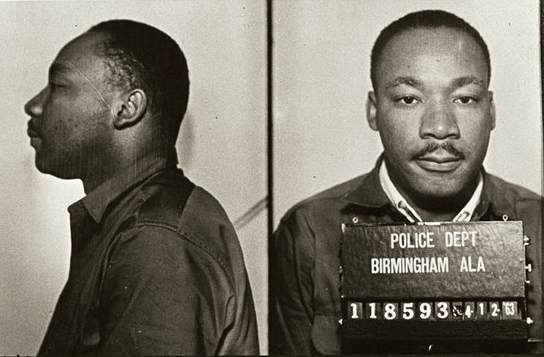

Today honors Martin Luther King Jr. He was a chronic adulterer who betrayed his wife and ordination vows. He kept a Communist Party USA member as a close advisor. He rejected Christian orthodoxy while in seminary.
MLK was also a great American. He successfully persuaded the nation that the Declaration of Independence and U.S. Constitution apply to all people. He insisted that Christianity and natural law required dignity and decency for all. God is no respecter of persons, certainly not based on color, MLK explained with unequaled eloquence.
King could have enjoyed the easy life of an upper middle class pastor. Instead, he realized that his divine calling was to trod the path of a martyr. He gained fame and glory amid constant danger to himself and his family. He admired the hymn by James Russell Lowell, “Once to Every Man and Nation,” whose words include:
By the light of burning martyrs,
Christ, Thy bleeding feet we track,
Toiling up new Calvaries ever
With the cross that turns not back;
While King’s sins were many, pride, pretension and sanctimony were not among them. His celebrity and superior talents did not prevent his easy camaraderie with regular people who lacked his status. MLK achieved by his assassination at age 39 what even the most successful people fail to achieve with twice as many years.
Like Abraham Lincoln, MLK reminded America of who it really is, through fire and flame, to the sacrifice of his life. He is an icon of liberty and justice to Americans but also to the world. America had slavery and racial injustice. But it also produced the Civil Rights Movement, which demonstrated to the world what oppressed people can achieve if they are brave and persistent.
The Civil Rights Movement, led by preachers like MLK, was largely the product of the black church. Secular voices had previously argued for civil rights but mostly without the same success. Only the churches could inspire and mobilize black people effectively. And only the churches and their clergy could deploy the spiritual message that could appeal to America’s conscience. America can long ignore its conscience but nearly always in the end surrenders to it. MLK understood America’s religious character.
As noted in today’s Providence article, MLK was influenced by Reinhold Niebuhr. While many Protestant Social Gospel advocates naively assumed society could be perfected through good will, MLK accepted Niebuhr’s point about human depravity:
While I still believed in man’s potential for good, Niebuhr made me realize his potential for evil as well. Moreover, Niebuhr helped me to recognize the complexity of man’s social involvement and the glaring reality of collective evil. Many pacifists, I felt, failed to see this.
MLK also thought Niebuhr under appreciated divine grace’s power to transform society:
“It was at Boston University that I came to see Niebuhr had overemphasized the corruption of human nature. His pessimism concerning human nature was not balanced by an optimism concerning divine nature. He was so involved in diagnosing man’s sickness of sin that he overlooked the cure of grace.”
Maybe MLK adopted this optimism about divine grace from the lingering Methodism of Boston School of Theology. It’s always a hard balance for social reformers, gaging what’s possible in a world of both fallen humanity and divine sovereignty. Sin and hate are always powerful but never insurmountable. God’s love and justice prevail, but only across a very long, crooked path.
MLK, although widely acclaimed, was not popular in his time. His legacy remained contested until recent years. Social reformers who challenge deeply embedded societal idols are rarely popular in their lifetimes. Their vindication usually belongs to posterity.
Nearly everyone now claims to agree with King’s insight about human dignity and equality, based on the Declaration of Independence, and Christianity. Yet many so-called social justice advocates think they can elevate society by deconstructing faith and America’s founding charters. They lack MLK’s wisdom, and they will fail.
Societies are rarely improved through revolution, which aims to destroy and replace. Instead, societies more often improve through reformation, building on preexisting strong foundations. MLK was a wise reformer, not, like many civil rights radicals, a revolutionary. Through Niebuhr, Christian Realism guided him.
If MLK was the prophet of civil rights, LBJ was the prince, enabling the Civil Rights Act and Voting Rights Act. Prophets can achieve little politically without princes. LBJ perhaps exceeded MLK in his infidelities and certainly in his crass vulgarity. But amid his vainglory and hubris, LBJ shared the same vision of an America living up to the Declaration of Independence. God uses unexpected instruments, whose utility is often fleeting.
MLK was a flawed but exceptional divine instrument for justice. No man deserves unqualified adulation. We are all dust and clay. But when God powerfully uses people to uplift the plight of suffering humanity, we should step back with awe and gratitude. As it was said long ago, there is a God in Israel. And per the children’s hymn, He holds the whole world in His hands.
No comments yet
The comments are closed.