By Keith Pavlischek
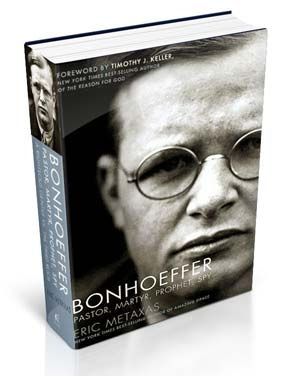
I’m reading Eric Metaxas’ wonderful biography Bonhoeffer: Pastor, Martyr, Prophet, Spy and ran across two passages that give some insight into both Karl Barth’s and Dietrich Bonhoeffer’s decidedly non-pacifist and anti-anti-war views toward confronting Nazi aggression.
Both theologians, of course, saw far more clearly and much earlier than most the evil of the Nazi regime. What was their attitude toward resistance to Nazi military aggression? We know, of course, that Bonhoeffer would eventually join the resistance and be executed for joining the plot to assassinate Hitler. But what was their attitude before Bonhoeffer formally joined the resistance?
During the Sudetenland crisis of 1937, Metaxas reminds us that it was widely thought that England and France would not stand for aggression against Czechoslovakia. He reminds us that many generals in the German high command knew it was naked aggression that would lead Germany into a world war she would lose. During this time, Barth wrote a letter to a friend (which was unfortunately made public). Barth said, “Every Czech soldier who fights and suffers will be doing so for us too, and I say this without reservation–he will also be doing it for the Church of Jesus, which in the atmosphere of Hitler and Mussolini must become the victim of either ridicule or extermination.” Barth was not, to say the least, “going all in” for appeasement and was not exactly “anti-war.”
Moreover, Metaxas tells us that Bonhoeffer and many in the German military high command were expecting that the coming invasion of Czechoslovakia would enable a military coup against Hitler. According to Metaxas, “Bonhoeffer knew a coup was imminent.” But that assumed Czech and European military resistance to the aggression. And then came Chamberlain, the “peaceful” annexation of the Sudetenland and…”peace in our time” and all that. (p. 312)
Which is something for our pacifist friends to think about.
Another passage worth pondering has Metaxas relating Bonhoeffer’s views in mid-October 1939 immediately following the Nazi invasion of Poland:
And what Bonhoeffer now knew would make him feel more alone than ever because many in the church and ecumenical world were expending great energies toward ending the war. But Bonhoeffer was not. He now believed that the principal goal was to remove Hitler from power. Only afterward could Germany negotiate for peace. Knowing what he knew, any peace with Hitler was no better than war. But he couldn’t say such things, even in ecumenical circles. (p. 350)
Again, something for our pacifist friends to think about.


Pingback by @TheIRD, Bonhoeffer and War « TheoNerd on September 30, 2012 at 8:28 pm
[…] on the IRD’s blog, Juicy Ecumenism, Keith Pavlischek writes about his thoughts on pacifism while reading Eric Metaxas’ biography of Di…, Bonhoeffer: Pastor, Martyr, Prophet, Spy. Pavlischek writes, Moreover, Metaxas tells us that […]
Comment by Dan Trabue on September 30, 2012 at 9:23 pm
So, it sounds like your argument is all based on fear that, without war, really bad things will happen. That, as opposed to Christians living up to Christ’s teachings.
Is that fair?
Comment by Saraspondence on October 1, 2012 at 11:34 am
What is Christ’s teaching about war? Chapter and verse please.
Comment by Dan Trabue on October 1, 2012 at 5:19 pm
He doesn’t have one, directly. He does tell us directly and clearly, Love your enemies, do GOOD to those who hate you, turn the other cheek, overcome evil with good.
Is it your estimation that when Jesus said to “love our enemies” he was intending to suggest that sometimes it’s okay to shoot them? To bomb them and their children, if they happen to be nearby?
If so, I don’t find that to be a faithful reading of the teachings of Christ and would disagree with your opinion.
On the other hand, we are also directly told to NOT shed innocent blood – a command from God to all people – and Jesus never gave us any exceptions to that teaching and the only place where we find God’s people going to war is sometimes in the OT and only at God’s direct instruction (and in those times, we see God’s direct instructions including behaviors that we would normally call “atrocities” – the killing of ALL the people, including women and children).
So, given that, even at a fairly OT-heavy/literalist-leaning, i think the best you could argue would be that SOMETIMES God has ordered people to war, but otherwise, the standard Christian teaching and biblical teaching is “Shed no innocent blood.”
Given THAT, I would think the best you might be able to argue (again, from a OT-heavy reading) is that it’s acceptable to kill aggressors, but any behavior that involves shedding innocent blood is strictly forbidden.
On what basis would you say it’s acceptable to sometimes shed innocent blood (or would you)? Chapter and verse, please.
If you want to argue for a war in which soldiers ONLY take actions that kill aggressor blood, I wouldn’t have such a problem with it. But as even the pope has suggested, it’s hard to imagine such a thing happening in modern warfare.
Comment by Enézio Almeida Filho on October 2, 2012 at 9:45 am
Praise God for those Allied soldiers and European civilians who fought and shed their blood fighting against Hitler – an evil I, as a Christian in the 21st century, would fight gladly!
Comment by Eric Lytle on October 2, 2012 at 11:28 am
So would I! Jesus’ words about loving one’s enemies and turning the other cheek were intended to keep us from personal vengeance, not from taking actions to protect other people from harm. Too many people read the New Testament as if it were some kind of political manifesto or blueprint for society, when in fact it was written to tell individual Christians how to conduct themselves in a world where unbelievers assume that it’s OK to get even with people who have wronged us.
Could I have pulled the trigger to take out Hitler? Stalin? Mao? Osama bin Laden? You bet – wouldn’t make me lose one wink of sleep.
Comment by Dan Trabue on October 2, 2012 at 11:48 am
Eric…
Jesus’ words about loving one’s enemies and turning the other cheek were intended to keep us from personal vengeance, not from taking actions to protect other people from harm.
And you know this, how?
What logical or biblical reason would you have for taking actions this collection of Christian teachings as ONLY being applicable to the individual life?
What I find interesting is that, at least in conservative Christian circles, they jump through all kinds of moral and logical circles to embrace a pretty literal Old Testament, but they don’t have much use for a literal set of teachings from Jesus.
Eric, I do I agree with you that too many people approach the Bible in general as if it were a blueprint for modern society and that its specific ancient rules ought to be taken fairly literally as still applying today.
I think what we rightly glean from a good and rational reading of the Bible are general principles: Love your enemies. Do not shed innocent blood. Take care of the poor. Live moral lives free from promiscuity. Say you’re sorry when you’re wrong. Etc.
But when we start trying to rip ancient rules from ancient contexts (Men should not lie with men. Kill them if they do.; When you attack an enemy, go in and kill them all, men, women and children; if a woman is raped, the attacker must marry her…), then we are setting ourselves up for all sorts of evil and/or misunderstanding.
Comment by dover1952 on October 2, 2012 at 12:30 pm
I pretty much agree with Dan. I tend to be a war hawk politically, but Dan is most likely correct in just about all that he has said above—and most of you others are dead wrong. In the red words of the New Testament, Jesus challenged all men and women to overcome the human nature within themselves.
If the Iranians drop a nuke on Tel Aviv, my first human nature inclination is to have the USS Ohio launch all of its ICBMs on Iran and kill all 70 million people who live there within the space of about 7 minutes, which could easily be done with the push of a few buttons. Some would commend that as Christ-like and a desire for holy justice. Knowing my own heart well enough, I know that justice has nothing to do with it. I want revenge—and I want it now. However, this is not the way of Jesus.
The truth of the matter is that for the past 2,000 years the churches and their leaders have spent an extraordinary amount of effort in crafting religious beliefs and cultural norms that are designed to side-step the red words of Jesus in the New Testament and allow human nature to continue to reign in human affairs, while making a properly corraled place for the church and giving the words of Jesus lip service. I think the religious right in the United States has taken this 2,000-year-old betrayal of Jesus and raised it to undrempt of cultural heights.
Keep on talking Dan Trabue. You are quite likely the only true voice of Jesus on this blog. Beware though. Talking like Jesus will get you crucified by most men—even the ones who claim to be Christians.
Comment by J P Logan on October 2, 2012 at 2:37 pm
Eric, you are onto something. This idea that being a Christian means being a gelding is just plain wrong. I think when liberals hear that Jesus said “turn the other cheek,” they assume they can browbeat Christians into being pacifists. They have no understanding of what Augustine and others said about “just war.” No wonder so many men are turned off by church, they see churches as a refuge for wimps, especially since so many pastors are. Our pastor when I was growing up was an ex-Marine, and when he preached he just oozed charisma.
Comment by Dan Trabue on October 2, 2012 at 5:08 pm
I’m less interested in what Augustine thought about what Jesus didn’t say and more interested in what Jesus DID say.
Again, I would ask what the biblical argument (not Augustinian argument) is to support the suggestion: Sometimes, we can kill our enemies and sometimes we can shed innocent blood.
By the way, like many pacifists/just peacemakers, I’m fairly aware of Augustine’s JWT ideas.
As to the whole wimp canard, I hardly think stepping up to the violent oppressor non-violently can in any reasonable way be called “wimpy.”
Show me your “courage” with bombs and guns, and I will gladly point you to real Christian courage in the face of bombs and guns, armed only with faith in God and God’s ways.
Comment by John on December 15, 2012 at 7:46 pm
Hi Dan.
If I started torturing your entire family to death, along with a couple of million of the world’s poor, and the *only* way for you to stop me was to kill me, what would be the right thing to do? To do nothing in the face of evil is not courage, only self-righteous legalism which worships the letter of pacifism over and above the love of Jesus Christ for the poor and oppressed. You are valuing your own ritual purity over and above the actual lives of your fellow human beings. Remember the golden rule – Jesus’ own definition of love – do as you would be done by. Now if you went mad and started torturing all your family to death, and the only way for you to be stopped was for someone, what would you hope happened?
That said, non-violent resistance is by and large a good thing. It’s just not always the answer… remember that pacifism was made for man, not man for pacifism.
Comment by Donnie on October 2, 2012 at 2:53 pm
Dan and Dover, what would YOU do to stop Hitler? And please, none of this “If everybody had been a pacifist then he never would have taken power” nonsense.
Comment by Dan Trabue on October 2, 2012 at 3:35 pm
Ideally, Donnie, I would do what I could to stop a Hitler AND adhere to Jesus’ teachings. I’d do that, because I’m a follower of Christ and believe in His Way.
Having said that, I will gladly also say that, if pushed to an impossible, lose/lose situation (“kill Hitler or 6 million people die”) and I knew that killing Hitler would save the 6 million people, I may well do that. What I wouldn’t do, though, is then proceed to say, “And since I saved 6 million people, then Jesus approves of what I did and what I did matches Jesus’ teachings…”
What I’m speaking of here is what Jesus and the Bible do and do not teach. We have no authority in the bible in any of its pages that I can see to engage in behavior that sheds innocent blood. We are commanded specifically NOT to do this. We are commanded specifically to love our enemies and to overcome evil NOT by fighting fire with fire/death with death, but to overcome evil with good.
So, while I might kill Hitler, given the chance and given foreknowledge that it would turn out all right, but I would not claim that my killing Hitler complied with Jesus’ teachings or the desires of God. I might do it, call it the lesser of two evils – but still an evil – and repent. But I just don’t think a serious reading of the Bible lets us call it “God’s will…”
If you have a passage where God says “Yes, it IS my will for Christians to engage in war and to slaughter the enemy,” by all means, point it out. But I’ll have to let you know, I’ve read the book and it ain’t in there.
Again, you all seem to be making the case, “I don’t know what else to do to stop evil and I’m afraid if I don’t resort to war, then even more evil will occur, so therefore, God approves of it…” rather than making a rational biblical case for your position.
If you want to admit, “I’m glad to engage in what I perceive to be a lesser evil to stop a greater evil, but I will ackknowledge that it’s still an evil and not God’s will…” then we could begin talking about the greater or lesser efficacy of war in various situations.
In general, I’m pretty convinced that Jesus’ ways are the best ways, even when dealing with a thug like Hitler and that NVDA/Just Peacemaking efforts will generally be the best way to “prevent a Hitler,” but I also will gladly admit that Jesus called us to follow in his steps and sometimes, walking in those steps leads us to oppression and harm, just as Jesus promised.
I still think walking in those steps is the best Way.
Comment by dover1952 on October 2, 2012 at 4:07 pm
I think it would be safe to say that there would have been nothing that Dan, I, or 10,000 other people could have done to stop Hitler, so we would probably have done nothing other than speak out in whatever venues were available.
Jesus says to go through the narrow gates and that few people will find them because most other people are rushing to the wide gates. To the best of my recollection, Jesus said nothing about forming great worldwide “Christian” organizations to sway geopolitics. The basic assumption of Jesus is that he will have very few true followers who are willing to really believe in every word he says and follow those words with the right attitude of heart. Therefore, either individually or as a group, the numbers of people such as Dan will always be small and ineffectual in fighting tyranny. Rather, and Jesus probably foresaw this, their purpose is to be salt and light in whatever interpersonal situation they find themselves in at the time they are alive. Jesus did not insert himself into the power politics and armed might of Rome or the Seleucids. He rejected the kingdom’s of the Earth when Satan offered them to him–as if he really ever owned them. He was willing to render unto Caesar the things that belonged to Caesar and stay on the side of a line that defined the things of God.
Really Donnie, if you think about it, your position flies straight into the face of the most central historical view within Christian fundamentalism, a view Christian fundamentalists have offered to me personally on several occasions:
“We are the separated remnant. We are the direct descendants of the first Christians that hid out in the catacombs and caves. We separated ourselves from the affairs of men and the great church movements (such as the Roman Catholic Church) from the 1st century all the way up until the late 19th century. We hid out in our quiet woodland homes, practiced our simple Christianity around our own hearths, and kept ourselves wholly separated from the great historical movements and religious strife among men in Europe and elsewhere. Only with the open advent of Christian fundamentalism in the late 19th did we finally move onto the public stage to openly draw men towards Jesus in these last times.”
The greatest single threat to Paul Weyrich’s view of a wholly politicized American church is that a vast number of Christian fundamentalists will return to this foundationally held view and abandon everything the religious right stands for in terms of politics and geopolitics—another separation of themselves from the culture and the world to follow Jesus and practice holiness and self-sanctification alone at their family hearths. Christian reconstructionism in all of its facets are doomed to failure because it is against the will of Jesus.
There you are Donnie.
Comment by Dan Trabue on October 2, 2012 at 4:30 pm
Dover…
Therefore, either individually or as a group, the numbers of people such as Dan will always be small and ineffectual in fighting tyranny.
I think this is a somewhat valid point – the more people who reject NVDA (Non-violent Direct Action), the less likely it is to work. The argument could be made, and I will be the first one to admit that Just Peacemaking efforts will never succeed perfectly (any more than efforts at stopping evil via war will succeed perfectly).
On the other hand, as the saying goes, never doubt that a small group of thoughtful people can change the world; indeed, it is the only thing that ever has…
We have seen variatons of more or less NVDA be effective in places such as Gandhi’s India, in the fight against Contra terrorism in Nicaragua, and in the various Arab Spring uprisings of late.
When Jesus prescribed facing violence by turning the other cheek or offering food and water to the “Enemy,” many of us think that this was not passive do-goodism, but reasoned and subversive ways of overcoming evil with Good. He not only preached this, he lived it and, as the Bible says, left us an example that we could follow in his steps.
I’d ask us to consider this, friends: In WWII, we eventually stopped Hitler using the war method. What was the cost of that solution? Did you know that over 60 million people died in that effort to stop evil? That there were over 40 million civilians killed?
Of course, we don’t know what the results of Just Peacemaking or NVDA efforts would have been, but could it really have been much worse? Of course, all guesses would just be speculation, but I have a hard time thinking it could have gone any worse than that.
Comment by dover1952 on October 2, 2012 at 6:07 pm
Dan. Thanks for the famous Margaret Mead quote. There is some truth to that. Of course, most of what we are discussing here is hyopthetical. All the famous German theologian got out of this was choking to death. He did not stop Hitler. I suspect the Holy Spirit got tired of the Third Reich and put and end to it. Only He has the power to get the bad guys this upset:
http://www.youtube.com/watch?v=pR5q0ajW8Ko
Comment by Tierce on October 4, 2012 at 11:18 am
Dover…
The setback that you are referencing here was a military one. That is to say that the enemy was more successful in killing German troops than Hitler had expected.
I find it interesting that you can see the Holy Spirit’s hand behind such slaughter, but unequivocally reject the possibility of a Christian involvement in such a “divine work.”
I think one of the biggest reasons why people struggle with this relates back to a lack of understanding of the concept of free will. This is not meant to highjack the thread into a Calvinism-Armenianism, or a God’s Sovereignty- Free Will debate.
I just want to point out that holding to God’s Sovereignty without a clearly articulated view of free will, leads to the point where people view the destruction of evil regimes as a direct work of God, which tends to beg the question, why shouldn’t Christians participate in such a work?
If we have a robust view of human free will, then that allows us to understand war as two evil forces competing, and then we can step back and choose not to side with either one. A student of traditional Calvinism would of course disagree, but then a student of traditional Calvinism is rather unlikely to be a pacifist of any kind.
Comment by Michael Snow on November 16, 2012 at 5:13 pm
We might ask how God used his servant, Dietrich Bonhoeffer. It certainly wasn’t to stop Hitler. But Bonhoeffer’s light still shines through the Cost of Discipleship, etc.
Christians are called to be the light of the world, not the sword of the LORD.
http://www.amazon.com/Christian-Pacifism-Fruit-Narrow-ebook/dp/B005RIKH62/ref=pd_rhf_dp_p_t_1